Course Description
Validate Security, Reduce Risk, and Strengthen Software Trust
The Advanced Secure Testing Expert (ASTE) certification by GIPMC is a senior-level professional credential designed to develop, validate, and recognize advanced secure testing and application security validation capabilities across modern software environments.
This certification emphasizes security-focused testing, vulnerability identification, risk-based validation, secure development alignment, and assurance-driven testing, preparing professionals to evaluate and strengthen security posture throughout the software lifecycle.
ASTE goes beyond functional testing. It equips professionals to identify security weaknesses, validate controls, assess risk exposure, and support secure software delivery in complex and evolving threat landscapes.
Why Advanced Secure Testing Expert (ASTE) from GIPMC?
The ASTE certification is built on industry-aligned secure testing and cybersecurity assurance competencies while remaining vendor-neutral, tool-agnostic, and technology-independent. This enables certified professionals to apply their expertise across platforms, architectures, and development environments.
Key Advantages
ASTE is designed for professionals responsible for security assurance, testing strategy, and risk validation.
Market Relevance
- 35–55% higher earning potential for secure testing and AppSec professionals
- 75%+ employer preference for security-focused testing expertise
- 50% reduction in security defects reaching production with structured secure testing
- 2–3x faster advancement into senior security assurance roles
(Based on aggregated cybersecurity hiring trends and secure software delivery benchmarks.)
These indicators highlight the demand for secure testing experts who proactively reduce security risk.
Who Should Pursue ASTE? (Target Audience)
The ASTE certification is suitable for professionals working in or advancing toward security-focused testing roles, including:
- Security Test Engineers
- Application Security Testers
- QA Leads with security responsibility
- Secure SDLC and DevSecOps professionals
- Penetration Testing and Vulnerability Assessment practitioners
- Software Test Architects
- Professionals transitioning into secure testing roles
ASTE provides a structured approach to validating security across the software lifecycle.
Detailed Learning Outcomes
By earning the Advanced Secure Testing Expert (ASTE), candidates demonstrate competencies consistent with a CAPM project management certification, including the ability to:
1. Secure Testing Foundations
- Security testing objectives and scope
- Threat awareness and security risk basics
- Role of secure testing in software assurance
2. Secure SDLC & Testing Integration
- Integrating security testing into development lifecycles
- Shift-left and continuous security validation concepts
- Collaboration with development and security teams
3. Threat Modeling & Risk Analysis
- Identifying attack surfaces
- Threat modeling techniques
- Risk prioritization for testing focus
4. Application Security Testing
- Secure testing of web and mobile applications
- Common vulnerability categories and detection methods
- Input validation, authentication, and authorization testing
5. API & Service Security Testing
- Testing APIs and microservices for security weaknesses
- Authentication, authorization, and data exposure validation
- Secure communication testing
6. Infrastructure & Environment Security Testing
- Testing configurations and deployment environments
- Cloud and container security validation concepts
- Environment hardening verification
7. Vulnerability Assessment Techniques
- Static and dynamic analysis concepts
- Manual and automated assessment approaches
- False positive analysis and validation
8. Penetration Testing Alignment
- Controlled exploitation techniques
- Ethical testing boundaries
- Reporting and remediation guidance
9. Secure Test Planning & Strategy
- Risk-based security test planning
- Coverage mapping and prioritization
- Secure test documentation
10. Security Defect Management
- Severity classification and impact analysis
- Secure defect reporting and tracking
- Verification of remediation effectiveness
11. Compliance & Security Standards Awareness
- Regulatory and compliance-driven testing considerations
- Security assurance reporting
- Audit support and evidence collection
12. Security Metrics & Reporting
- Meaningful security testing metrics
- Executive-level risk reporting
- Continuous improvement insights
13. Secure Testing Review & Maturity Improvement
- Secure testing maturity assessment
- Continuous improvement planning
- Knowledge transfer and capability building
Professional and Career Benefits
ASTE-certified professionals are recognized for their ability to:
- Identify and validate security vulnerabilities effectively
- Reduce security risk before production deployment
- Support secure software delivery initiatives
- Communicate security risks clearly to stakeholders
- Strengthen organizational security posture
The certification enhances credibility and opens opportunities in roles such as:
- Secure Testing Expert
- Application Security Tester
- Security QA Lead
- DevSecOps Security Specialist
- Vulnerability Assessment Consultant
- Security Assurance Lead
Certification Validity & Renewal
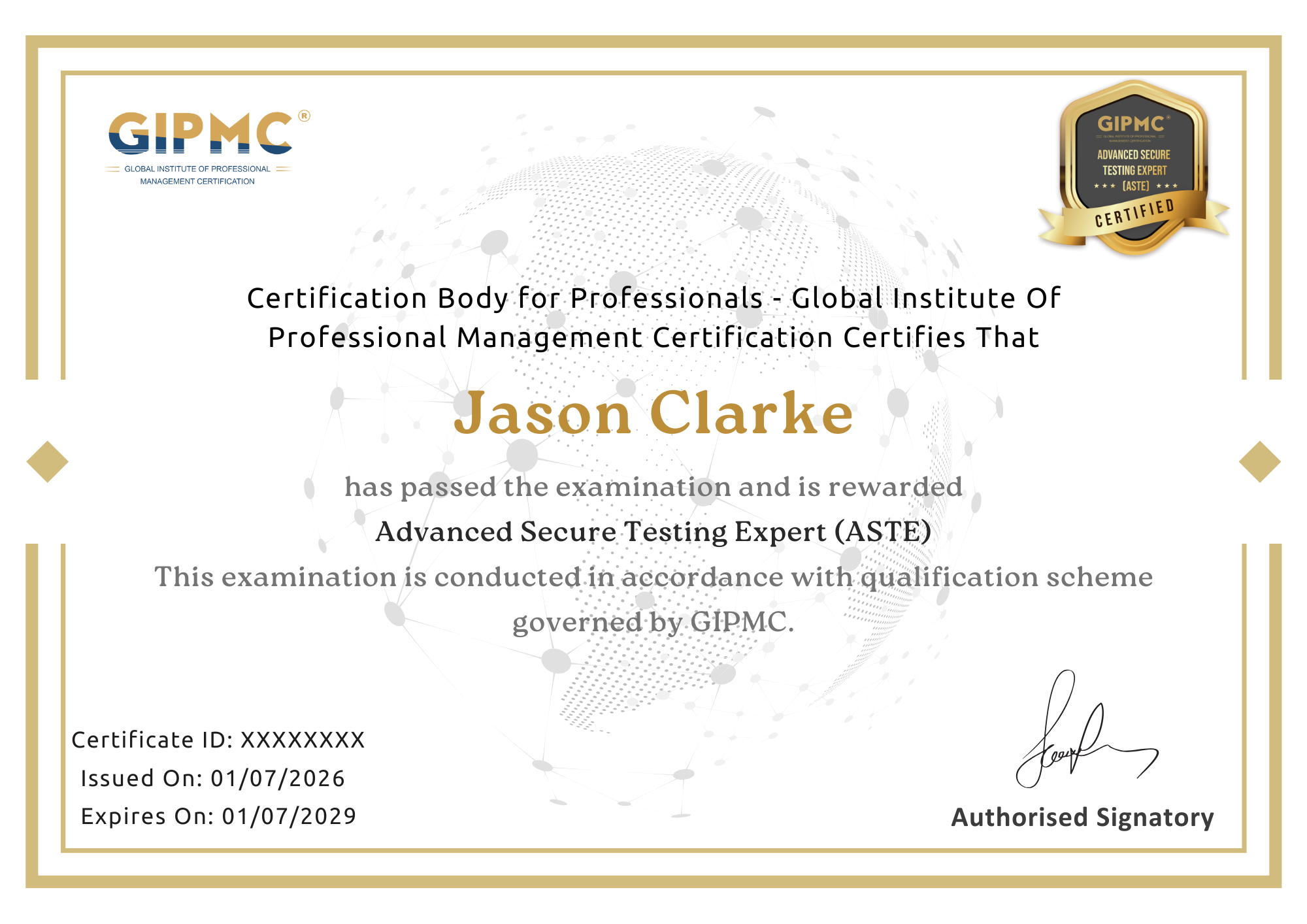
The Advanced Secure Testing Expert (ASTE) certification issued by GIPMC is valid for three (3) years from the date of certification award.
Renewal Purpose
Renewal is designed to:
- Maintain professional credibility in a fast-evolving threat landscape
- Ensure alignment with current secure testing practices
- Protect the long-term value of the certification
Renewal Process Includes
- Completion of continuing professional development or knowledge refresh activities
- Renewal assessment or professional verification, as applicable
- Submission of renewal application before certification expiry
Timely renewal allows professionals to retain active certification status without interruption.