Course Description
Provide Strategic Oversight and Accountability for Artificial Intelligence
The Board-Level AI Governance Certification (BAIGC) by GIPMC is an executive-level credential designed to develop, validate, and recognize AI governance, oversight, and accountability capabilities at the board and senior leadership level.
This certification focuses on strategic AI risk oversight, governance responsibilities, regulatory exposure, ethical accountability, and enterprise-wide control, enabling board members and senior executives to govern AI confidently without requiring technical depth.
BAIGC equips leaders to ask the right questions, set governance expectations, oversee AI risk responsibly, and ensure AI initiatives align with organizational values, strategy, and legal obligations.
Why Board-Level AI Governance Certification (BAIGC) from GIPMC?
As Artificial Intelligence increasingly influences strategy, risk, compliance, and reputation, AI governance is no longer a technical issue—it is a board-level responsibility. The Board-Level AI Governance Certification (BAIGC) from GIPMC is specifically designed to equip board members, CXOs, and senior leaders with the governance knowledge required to oversee AI responsibly, ethically, and strategically.
BAIGC focuses on AI risk oversight, regulatory readiness, ethical accountability, and decision governance, enabling boards to ask the right questions, set clear AI policies, and ensure alignment with organizational values and legal obligations. Unlike technical AI certifications, BAIGC addresses strategic control, fiduciary duty, and long-term impact, helping leaders safeguard trust while enabling innovation.
By choosing BAIGC, organizations benefit from:
-
Board-ready AI governance frameworks aligned with global best practices
-
Clear understanding of AI risks, bias, compliance, and accountability
-
Improved oversight of AI investments and vendor decisions
-
Stronger stakeholder trust, regulatory confidence, and reputational protection
The GIPMC BAIGC certification ensures that boards are not merely informed about AI—but are prepared to govern it effectively, making it an essential credential for leaders shaping the future of AI-driven organizations.
Market Relevance
- 80%+ boards identify AI as a material enterprise risk
- 3× increase in regulatory scrutiny of AI usage globally
- 60% of organizations lack formal board-level AI oversight
- 50% reduction in governance risk with active board engagement
(Based on aggregated enterprise risk, governance, and regulatory trend analysis.)
These realities underscore why AI governance is now a board-level responsibility.
Who Should Pursue BAIGC?
The Board-Level AI Governance Certification (BAIGC) is specifically designed for:
- Board Directors and Non-Executive Directors
- Chairs of Audit, Risk, and Technology Committees
- CEOs, COOs, and C-Suite Executives
- Chief Risk, Compliance, and Governance Officers
- Senior Legal and Regulatory Leaders
- Public Sector and Regulatory Board Members
- Trustees and Oversight Council Members
BAIGC is for leaders responsible for enterprise accountability—not execution.
Detailed Learning Outcomes
By earning the Board-Level AI Governance Certification (BAIGC), candidates demonstrate competencies consistent with a CAPM project management certification, including the the ability to:
1. Board Responsibility for AI Governance
- Fiduciary and oversight duties related to AI
- Accountability models for AI systems
- Board vs management roles
2. Understanding AI at Board Level
- What boards need to know about AI
- Capabilities, limitations, and misconceptions
- Avoiding technical overreach
3. AI as an Enterprise Risk
- Strategic, operational, legal, and ethical AI risks
- AI risk categorization at board level
- Risk appetite and tolerance
4. Regulatory & Legal Exposure
- Overview of global AI regulatory direction
- Board accountability and liability awareness
- Oversight of compliance readiness
5. Ethical Governance & Public Trust
- Fairness, transparency, and societal impact
- Reputation and stakeholder trust
- Ethical leadership expectations
6. AI Governance Frameworks (Board View)
- Governance structures and committees
- Decision rights and escalation paths
- Board oversight mechanisms
7. AI Strategy Oversight
- Aligning AI initiatives with enterprise strategy
- Investment oversight and value realization
- Preventing uncontrolled AI adoption
8. Oversight of Data & Model Risk
- Data governance implications
- Model risk awareness
- Assurance expectations
9. AI Incidents & Crisis Oversight
- Board role during AI failures or incidents
- Regulatory response readiness
- Communication and accountability
10. Assurance, Audit & Reporting
- What boards should expect from AI assurance
- Metrics and dashboards
- Independent review and validation
11. Management Accountability
- Defining management responsibilities
- Performance and governance KPIs
- Incentives and controls
12. Future-Readiness & AI Evolution
- Preparing for rapid AI advancement
- Scenario planning and adaptability
- Continuous governance improvement
13. Establishing a Board-Level AI Governance Culture
- Embedding oversight into board practices
- Continuous education and awareness
- Sustaining responsible AI leadership
Professional and Career Benefits
BAIGC certified leaders are recognized for their ability to:
- Provide confident AI oversight at board level
- Reduce regulatory, legal, and reputational exposure
- Strengthen enterprise governance and accountability
- Improve strategic alignment of AI initiatives
- Enhance stakeholder and public trust
BAIGC supports governance excellence in roles such as:
- Board Director with AI Oversight
- Chair of AI, Risk, or Technology Committees
- Executive Sponsor for Responsible AI
- Senior Advisor on AI Governance
- Public Sector and Regulatory Board Member
Certification Validity & Renewal
Certification Validity:
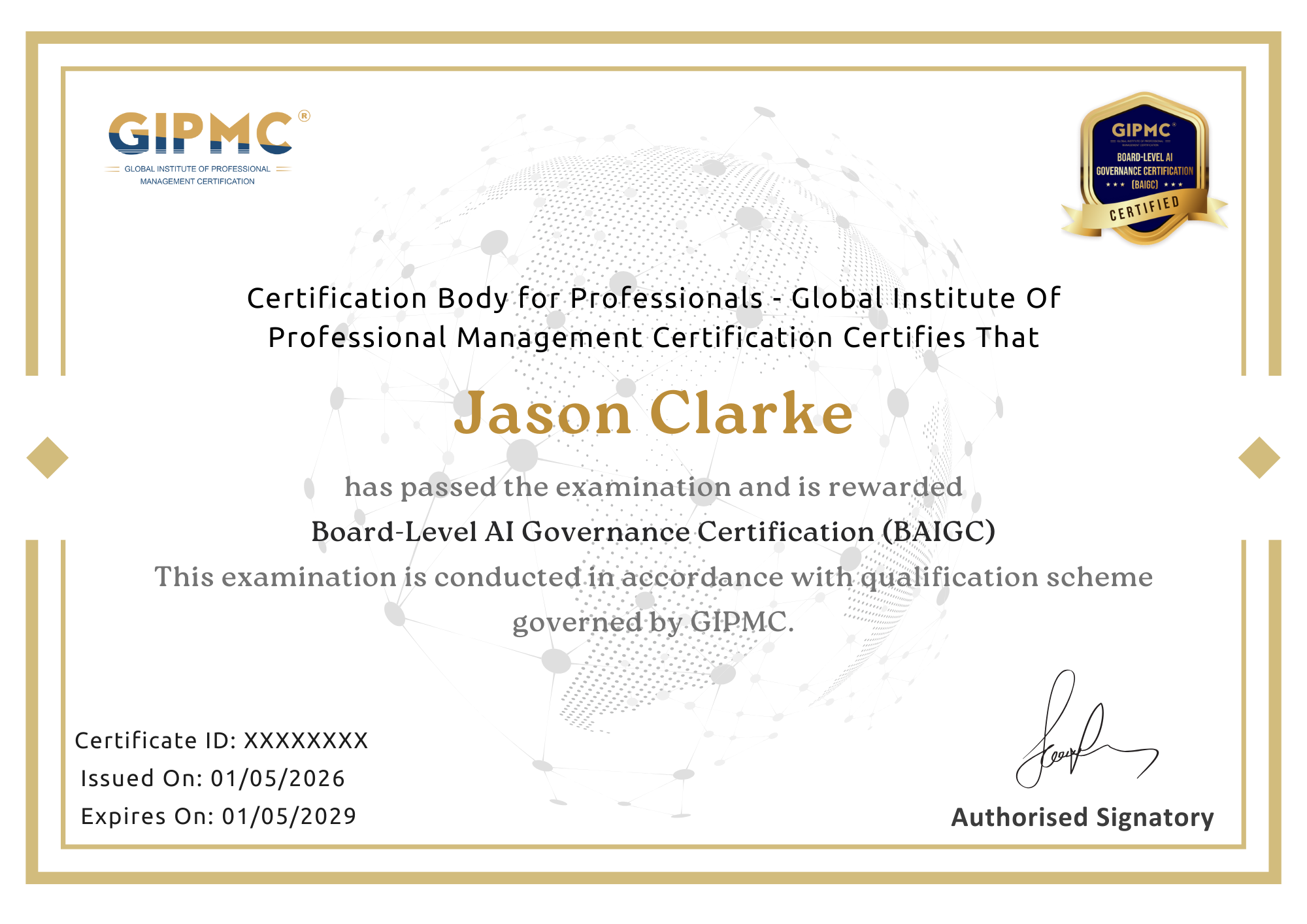
The Board-Level AI Governance Certification (BAIGC) is valid for three (3) years from the date of award.
Renewal Purpose
- Maintain awareness of evolving AI risks and regulations
- Ensure continued governance competence
- Protect the credibility and relevance of board-level certification
Renewal Process Includes
- Completion of a structured executive knowledge refresh
- Renewal verification or governance review (as applicable)
- Submission of renewal application prior to certification expiry
Timely renewal allows professionals to retain active certification status without interruption.