Course Description
Engineering, Deploying, and Operating Machine Learning Systems at Scale
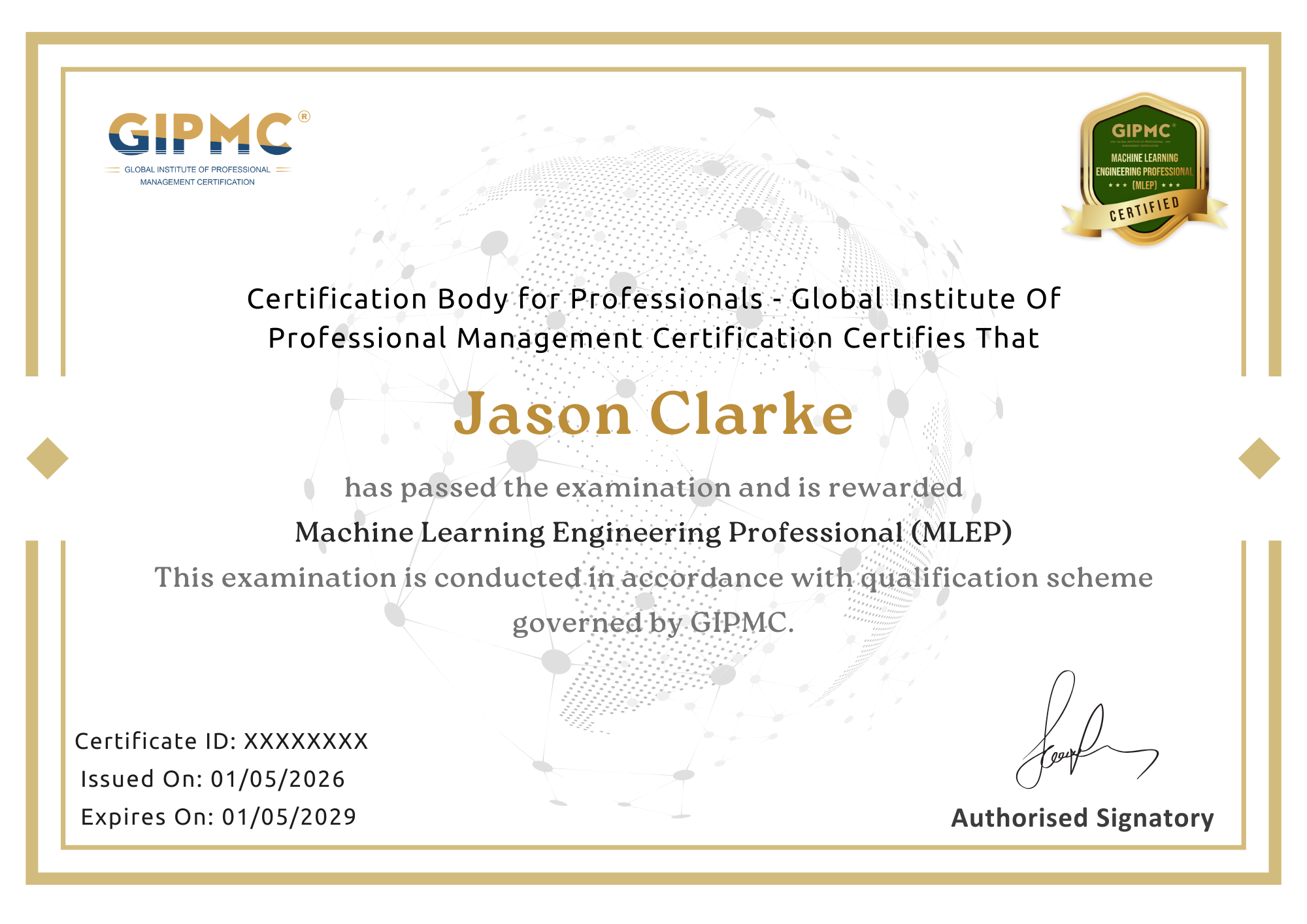
The Machine Learning Engineering Professional (MLEP) certification is a professional credential designed to develop, validate, and recognize engineering-level capability in building, deploying, monitoring, and maintaining machine learning systems in real-world production environments.
This certification prepares professionals to move beyond experimentation and model development into reliable, scalable, and secure machine learning engineering. It emphasizes system design, data pipelines, model deployment, performance optimization, monitoring, and lifecycle management, ensuring machine learning solutions deliver sustained business value.
MLEP goes beyond data science theory by equipping professionals with the engineering discipline and operational mindset required to run machine learning systems as dependable production services.
Why Machine Learning Engineering Professional (MLEP) from GIPMC?
Organizations increasingly struggle not with building models, but with operationalizing machine learning reliably at scale. MLEP is vendor-neutral, framework-agnostic, and production-focused, enabling professionals to apply skills across different tools, platforms, and industries.
Key Advantages
- Strong focus on production-grade machine learning systems
- Vendor- and framework-neutral engineering approach
- Emphasis on scalability, reliability, and maintainability
- Covers full ML lifecycle from data to deployment
- Applicable across cloud, on-premises, and hybrid environments
MLEP is designed for professionals operating at the intersection of machine learning, software engineering, and operations.
Market Relevance
As organizations expand AI adoption, demand for professionals who can engineer and operate ML systems continues to rise sharply.
- 65–85% of AI initiatives fail to reach production due to lack of ML engineering capability
- 70–85% employer preference for professionals with demonstrated machine learning engineering skills
- 40–60% reduction in deployment failures and model downtime when ML systems follow structured engineering practices
- 2x faster time-to-production for ML initiatives led by trained machine learning engineers
(Based on aggregated global AI adoption, MLOps maturity, and technology workforce trends.)
These figures demonstrate why machine learning engineering has become a critical and high-demand profession.
Who Should Pursue Machine Learning Engineering Professional (MLEP)? (Target Audience)
The Machine Learning Engineering Professional (MLEP) certification is suitable for professionals responsible for building or operating ML systems, including:
- Machine Learning Engineers
- AI and Data Engineers
- Software Engineers working with ML systems
- MLOps and Platform Engineers
- Cloud and Infrastructure Engineers supporting ML workloads
- Data Scientists transitioning into production roles
- Technical Professionals supporting AI-driven products
Across industries, MLEP provides a common engineering framework for production machine learning systems.
Detailed Learning Outcomes
By earning the Machine Learning Engineering Professional (MLEP), candidates demonstrate competencies consistent with a CAPM project management certification, including the ability to:
1. Fundamentals of Machine Learning Engineering
- Difference between ML research and ML engineering
- ML system lifecycle and operational challenges
- Role of ML engineering in business outcomes
2. Data Pipelines and Feature Engineering
- Designing reliable data ingestion pipelines
- Feature generation, validation, and versioning
- Managing data quality and drift
3. Model Training and Experiment Management
- Training workflows and reproducibility
- Experiment tracking and comparison
- Managing training infrastructure
4. Software Engineering for ML Systems
- Writing maintainable ML code
- Testing ML pipelines and components
- Managing dependencies and environments
5. Model Packaging and Deployment
- Serving models in production
- Batch, real-time, and streaming inference
- Deployment strategies and rollbacks
6. Infrastructure for Machine Learning
- Compute, storage, and networking for ML workloads
- GPU and accelerator considerations
- Scaling ML infrastructure
7. MLOps Pipelines and Automation
- CI/CD concepts for ML systems
- Automating training, testing, and deployment
- Managing model and pipeline versions
8. Performance Optimization and Cost Management
- Optimizing latency, throughput, and resource usage
- Managing inference and training costs
- Balancing performance and efficiency
9. Monitoring, Logging, and Observability
- Monitoring model performance and system health
- Detecting data drift, model decay, and anomalies
- Logging for audit and troubleshooting
10. Reliability, Resilience, and Incident Management
- Designing for availability and fault tolerance
- Handling failures and degraded performance
- Incident response for ML services
11. Security, Privacy, and Compliance
- Securing ML pipelines and endpoints
- Protecting sensitive data and models
- Supporting regulatory and organizational compliance
12. Responsible AI and Risk Management
- Managing bias, fairness, and explainability
- Human oversight and validation controls
- Reducing ethical and operational risks
13. Professional Practice and ML Engineering Maturity
- Collaborating with product, data, and operations teams
- Documentation and standardization
- Advancing toward senior ML engineering roles
Professional and Career Benefits
Machine Learning Engineering Professional (MLEP) certified professionals are recognized for their ability to:
- Engineer reliable and scalable ML systems
- Bridge the gap between data science and production
- Reduce operational failures and deployment risks
- Accelerate AI value delivery
- Support long-term sustainability of ML solutions
The certification supports career advancement into roles such as:
- Machine Learning Engineer
- Senior ML or AI Engineer
- MLOps or Platform Engineer
- AI Infrastructure Engineer
- ML Systems Architect
- Technical Lead for AI Products
Certification Validity & Renewal
Renewal is designed to:
- Maintain professional credibility
- Ensure continued alignment with evolving machine learning engineering practices
- Protect the long-term value of the certification
Renewal Process Includes:
- Completion of defined continuing professional development or knowledge refresh requirements
- Successful renewal assessment or verification, as applicable
- Submission of renewal application before certification expiry
Timely renewal allows professionals to retain active certification status without interruption.