Course Description
Change & Problem Analysis Specialist (CPAS)
Diagnose Challenges, Manage Change, and Drive Sustainable Solutions
The Change & Problem Analysis Specialist (CPAS) certification is a professional credential designed to build and validate expertise in structured problem analysis, change management, and organizational improvement. It equips professionals with analytical frameworks, diagnostic techniques, and change execution skills required to identify root causes, manage uncertainty, and implement effective, sustainable solutions.
CPAS emphasizes critical thinking, data-driven decision-making, and human-centered change practices, enabling professionals to respond effectively to operational issues, process inefficiencies, and transformation initiatives in both stable and rapidly evolving environments.
Why Change & Problem Analysis Specialist (CPAS) from GIPMC?
The CPAS certification is built on industry-agnostic, role-neutral principles, allowing professionals to apply their skills across sectors, functions, and organizational structures. Rather than relying on a single methodology, CPAS develops adaptable problem-solving and change leadership capabilities applicable to real-world scenarios.
Key Advantages
- Globally relevant change and problem analysis framework
- Balanced focus on analytical rigor and people-centric change
- Practical, scenario-based learning approach
- Applicable across business, technology, operations, and service environments
- Career-oriented credential with strong organizational relevance
CPAS supports professionals at various career stages, from individual contributors to leaders driving enterprise change.
Market Relevance
- Organizations with structured change practices report up to 35% higher success rates in transformation initiatives
- Professionals skilled in problem analysis are 40% more likely to be selected for critical improvement projects
- Effective root cause analysis reduces recurring issues by 30–50%
- Change-ready teams adapt faster and demonstrate higher performance consistency
(Based on aggregated industry change management and operational excellence trends.)
As organizations face increasing complexity, professionals who can analyze problems and manage change effectively are in high demand.
Who Should Pursue CPAS? (Target Audience)
The Change & Problem Analysis Specialist (CPAS) certification is suitable for professionals involved in improvement, transformation, or decision-making roles, including:
- Business Analysts and Process Analysts
- Change Managers and Transformation Leads
- Operations and Continuous Improvement Professionals
- Project and Program Managers
- Quality and Risk Management Professionals
- Team Leaders and Supervisors
- Consultants and Advisory Professionals
- Professionals seeking structured problem-solving and change expertise
CPAS provides a shared language and structured approach for diagnosing issues and guiding change across industries.
Detailed Learning Outcomes
By earning the Change & Problem Analysis Specialist (CPAS), candidates demonstrate competencies consistent with a CAPM project management certification, including the ability to:
1. Foundations of Change & Problem Analysis
- Understanding problems, symptoms, and impacts
- Types of organizational change and complexity
- Principles of structured analysis and decision-making
2. Problem Definition & Framing
- Clearly defining problems and objectives
- Distinguishing causes from effects
- Establishing problem boundaries and assumptions
3. Data Collection & Situation Assessment
- Identifying relevant qualitative and quantitative data
- Stakeholder input and evidence gathering
- Assessing current-state performance
4. Root Cause Analysis Techniques
- Cause-and-effect analysis methods
- Systemic and process-based root cause identification
- Avoiding bias and premature conclusions
5. Solution Development & Evaluation
- Generating viable solution options
- Evaluating feasibility, risk, and impact
- Selecting optimal solutions aligned with objectives
6. Change Impact Analysis
- Assessing organizational and operational impacts
- Identifying affected stakeholders and processes
- Readiness and resistance considerations
7. Change Planning & Strategy
- Designing structured change approaches
- Defining milestones, responsibilities, and success criteria
- Aligning change initiatives with business goals
8. Stakeholder Engagement & Communication
- Stakeholder identification and analysis
- Communication planning for change initiatives
- Managing expectations and addressing concerns
9. Risk Identification & Mitigation
- Identifying risks associated with change and solutions
- Developing mitigation and contingency strategies
- Escalation and decision governance
10. Implementation & Execution Control
- Coordinating solution rollout activities
- Monitoring progress and issue resolution
- Adjusting plans based on feedback and results
11. Measurement & Performance Validation
- Defining success metrics and KPIs
- Evaluating outcomes against objectives
- Ensuring benefits realization
12. Sustaining Change & Continuous Improvement
- Reinforcing new ways of working
- Knowledge transfer and documentation
- Continuous learning and improvement cycles
13. Review, Lessons Learned & Knowledge Management
- Post-implementation review practices
- Capturing insights and improvement opportunities
- Organizational learning and maturity development
Professional and Career Benefits
CPAS-certified professionals are recognized for their ability to:
- Diagnose complex problems with clarity and structure
- Identify root causes rather than treating symptoms
- Lead and support change initiatives effectively
- Reduce operational risk and recurring issues
- Enable sustainable improvements and organizational resilience
Career Opportunities Include:
- Change & Transformation Specialist
- Business or Process Analyst
- Continuous Improvement Lead
- Operations Excellence Manager
- Risk & Quality Analyst
- Management Consultant
- Organizational Development Professional
Certification Validity & Renewal
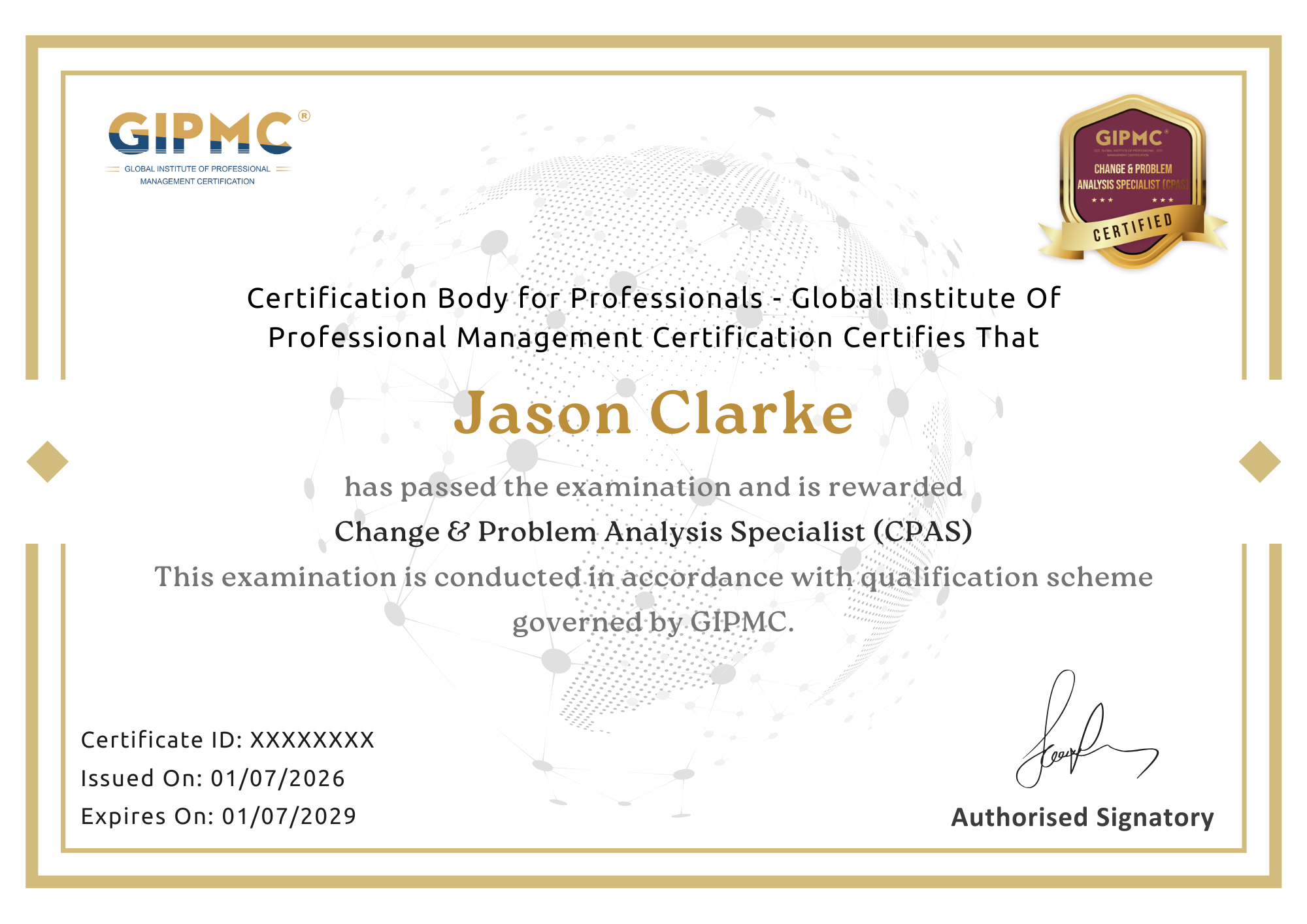
The Change & Problem Analysis Specialist (CPAS) certification is valid for three (3) years from the date of certification award.
Renewal Objectives
- Maintain analytical and change management relevance
- Stay aligned with evolving organizational practices
- Protect the long-term value of the credential
Renewal Requirements Include:
- Completion of defined continuing learning or professional development activities
- Successful renewal assessment or competency verification, as applicable
- Submission of renewal application prior to certification expiration
Timely renewal allows professionals to retain active certification status without interruption.