Course Description
The Information Security Governance Manager (ISGM) certification is a senior-level professional credential designed to develop, validate, and recognize expertise in information security governance, risk management, and regulatory oversight.
ISGM prepares professionals to design, implement, and oversee enterprise information security governance frameworks that align security strategy with business objectives. The certification emphasizes policy-driven security, accountability, and executive oversight, enabling organizations to manage cyber risk effectively while supporting operational resilience.
ISGM goes beyond technical security controls. It equips leaders with the capability to govern security programs, influence executive decisions, and ensure continue.
Why Information Security Governance Manager (ISGM) from GIPMC?
ISGM is built on enterprise security governance and risk management principles, remaining framework-aligned and technology-neutral. This allows certified professionals to apply governance expertise across diverse industries, regulatory environments, and security architectures.
Key Advantages
- Enterprise-focused information security governance framework
- Emphasis on strategy, risk, compliance, and accountability
- Coverage of policies, controls, and governance operating models
- Applicable across industries including finance, healthcare, technology, government, and critical infrastructure
- Career-defining credential aligned with senior security governance and leadership roles
ISGM supports professionals responsible for organizational security direction and oversight.
Market Relevance
- Cybersecurity failures cost organizations an average of 3–5% of annual revenue
- Poor security governance contributes to 40–55% of major security incidents
- Organizations with mature security governance reduce cyber risk exposure by 30–50%
- 75% of boards now expect regular information security risk reporting
- Enterprises with structured governance frameworks achieve 2× faster compliance readiness
(Based on aggregated enterprise cybersecurity governance, risk management, and regulatory compliance trends.)
These figures demonstrate the growing demand for leaders who can govern information security effectively.
Who Should Pursue ISGM? (Target Audience)
The ISGM certification is designed for professionals responsible for security governance and oversight, including:
- Information Security Managers and Directors
- Security Governance, Risk, and Compliance (GRC) Leaders
- Chief Information Security Officer (CISO) Deputies
- IT Risk and Compliance Managers
- Enterprise Risk Management Professionals
- Security Auditors and Assurance Leads
- Senior Consultants in information security governance
ISGM provides a strategic governance framework for enterprise security leadership.
Detailed Learning Outcomes
By earning the Information Security Governance Manager (ISGM), candidates demonstrate competencies consistent with a CAPM project management certification, including the ability to:
1. Foundations of Information Security Governance
- Role of governance in enterprise security
- Alignment between security and business strategy
- Executive accountability and oversight
2. Security Strategy & Governance Frameworks
- Developing security governance models
- Defining roles, responsibilities, and decision rights
- Integrating security into enterprise governance
3. Information Security Policies & Standards
- Policy development and maintenance
- Translating strategy into enforceable standards
- Managing exceptions and approvals
4. Risk Management & Threat Oversight
- Identifying and assessing information security risks
- Risk treatment and acceptance decisions
- Reporting risk to executive leadership
5. Regulatory Compliance & Legal Obligations
- Understanding regulatory requirements
- Managing compliance programs
- Coordinating audits and assessments
6. Security Controls & Assurance
- Oversight of preventive and detective controls
- Assurance activities and control validation
- Continuous control monitoring
7. Third-Party & Supply Chain Security Governance
- Governing vendor and partner security risks
- Contractual and compliance requirements
- Ongoing risk assessment
8. Incident Governance & Escalation
- Security incident governance structures
- Executive escalation and communication
- Post-incident review and improvement
9. Metrics, Reporting & Executive Dashboards
- Defining security KPIs and KRIs
- Board-level reporting
- Measuring governance effectiveness
10. Security Awareness & Organizational Culture
- Promoting security accountability
- Executive sponsorship and engagement
- Embedding security culture
11. Budgeting & Resource Governance
- Security investment prioritization
- Cost-benefit analysis
- Governing security spend
12. Integration with Enterprise Risk & IT Governance
- Aligning with enterprise risk management
- Coordination with IT governance
- Holistic organizational oversight
13. Governance Maturity & Continuous Improvement
- Assessing governance maturity
- Identifying improvement opportunities
- Evolving governance with business change
Professional and Career Benefits
ISGM-certified professionals are recognized for their ability
- Govern enterprise information security effectively
- Reduce organizational cyber risk exposure
- Improve compliance and audit outcomes
- Communicate security risks at executive and board levels
- • Align security initiatives with business objectives
The certification supports career advancement into roles such as:
- Information Security Governance Manager
- Security GRC Director
- Deputy or Acting CISO
- IT Risk and Compliance Leader
- • Security Governance Consultant
Certification Validity & Renewal
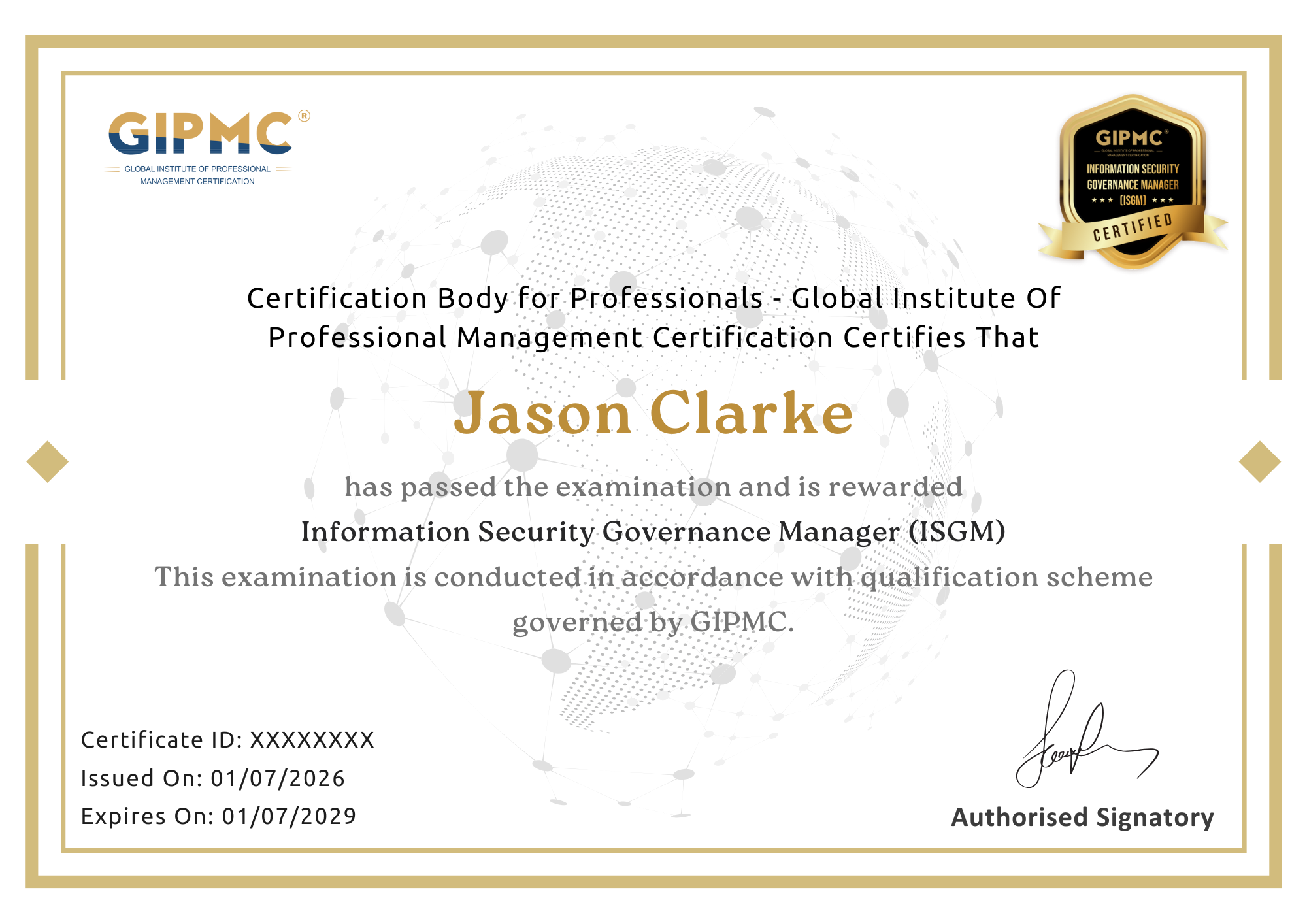
The Information Security Governance Manager (ISGM) certification is valid for three (3) years from the date of award
Renewal Objectives
- Maintain relevance with evolving cyber risk and governance practices
- Reinforce leadership, accountability, and compliance expertise
- Protect long-term credential value
Renewal Requirements
- Completion of approved professional development or security governance knowledge refresh activities
- Successful renewal assessment or verification, as applicable
- Submission of renewal application prior to certification expiry
Timely renewal allows professionals to retain active certification status without interruption.