Course Description
Building Strong Foundations in Software Quality and Testing Excellence
The Foundation Software Tester Credential (FSTC) is an entry-to-intermediate professional credential designed to develop, validate, and recognize core software testing knowledge, quality assurance principles, and testing best practices.
FSTC prepares professionals to contribute effectively to software development and delivery by ensuring functionality, reliability, usability, and quality of software products. The certification emphasizes structured testing fundamentals, enabling individuals to support defect prevention, early issue detection, and continuous quality improvement.
FSTC goes beyond tool usage. It equips learners with a solid conceptual foundation in software testing that applies across technologies, development models, and industries.
Why Foundation Software Tester Credential (FSTC) from GIPMC?
FSTC is built on internationally recognized software testing concepts, remaining methodology-neutral and tool-agnostic. This allows certified professionals to apply testing knowledge across waterfall, agile, DevOps, and hybrid environments.
Key Advantages
- Strong foundation in software testing principles and terminology
- Balanced coverage of manual testing, test design, and defect management
- Emphasis on quality mindset and early testing involvement
- Applicable across industries including IT services, product development, fintech, healthcare, telecom, and e-commerce
- Career-oriented credential aligned with entry and junior testing roles
FSTC supports individuals beginning or strengthening their careers in software testing and quality assurance.
Market Relevance
- Software defects discovered late increase fixing costs by 5–10× compared to early detection
- 40–50% of development effort is impacted by poor quality and rework
- Organizations with structured testing practices reduce production defects by 30–45%
- 70%+ software teams consider dedicated testing essential for reliable releases
- Entry-level testing roles account for 25–35% of QA hiring demand globally
(Based on aggregated software quality, testing efficiency, and IT delivery trends.)
These figures highlight why foundational software testing skills remain critical in modern software development.
Who Should Pursue FSTC? (Target Audience)
The FSTC credential is suitable for individuals involved in or aspiring to software testing and quality roles, including:
- Aspiring Software Testers and QA Professionals
- Entry-Level Test Engineers
- Developers seeking testing fundamentals
- Business Analysts involved in requirements validation
- IT Graduates and Career Starters
- Manual Testers formalizing their testing knowledge
- Professionals transitioning into QA and testing roles
FSTC provides a common foundation and language for software quality assurance.
Detailed Learning Outcomes
By earning the Foundation Software Tester Credential (FSTC), candidates demonstrate competencies consistent with a CAPM project management certification, including the the ability to:
1. Fundamentals of Software Testing
- Purpose and importance of software testing
- Quality assurance vs quality control
- Common testing myths and principles
2. Software Development & Testing Lifecycle
- Software development lifecycle models
- Role of testing in each phase
- Early testing and defect prevention
3. Types & Levels of Testing
- Functional and non-functional testing
- Unit, integration, system, and acceptance testing
- Regression and re-testing concepts
4. Static Testing & Reviews
- Reviews, walkthroughs, and inspections
- Benefits of early defect detection
- Role of static analysis
5. Test Design Techniques
- Black-box testing techniques
- Equivalence partitioning and boundary value analysis
- Decision tables and use case testing
6. Test Planning & Documentation
- Test plans, test cases, and test scenarios
- Entry and exit criteria
- Traceability between requirements and tests
7. Test Execution & Defect Management
- Test execution process
- Defect lifecycle and severity classification
- Reporting and tracking defects
8. Test Environment & Data Management
- Test environments and configurations
- Managing test data
- Environment-related risks
9. Agile & DevOps Testing Basics
- Testing in agile teams
- Continuous testing concepts
- Collaboration between testers and developers
10. Test Tools & Automation Awareness
- Overview of testing tools
- Manual vs automated testing
- When automation is appropriate
11. Quality Metrics & Reporting
- Basic test metrics
- Test progress and quality reporting
- Using metrics responsibly
12. Risk-Based Testing
- Identifying and prioritizing test risks
- Aligning testing effort with business risk
- Focused testing strategies
13. Professional Ethics & Continuous Improvement
- Ethical behavior in testing
- Learning from defects and failures
- Building a quality-focused mindset
Professional and Career Benefits
FSTC-certified professionals are recognized for their ability to:
- Apply fundamental software testing principles confidently
- Contribute to improved software quality and reliability
- Detect defects early and reduce rework
- Communicate testing outcomes effectively
- Build a strong foundation for advanced testing roles
The credential supports career progression into roles such as:
- Software Tester
- QA Analyst
- Junior Test Engineer
- Manual Tester
- Quality Assurance Associate
- Software Quality Support Professional
Certification Validity & Renewal
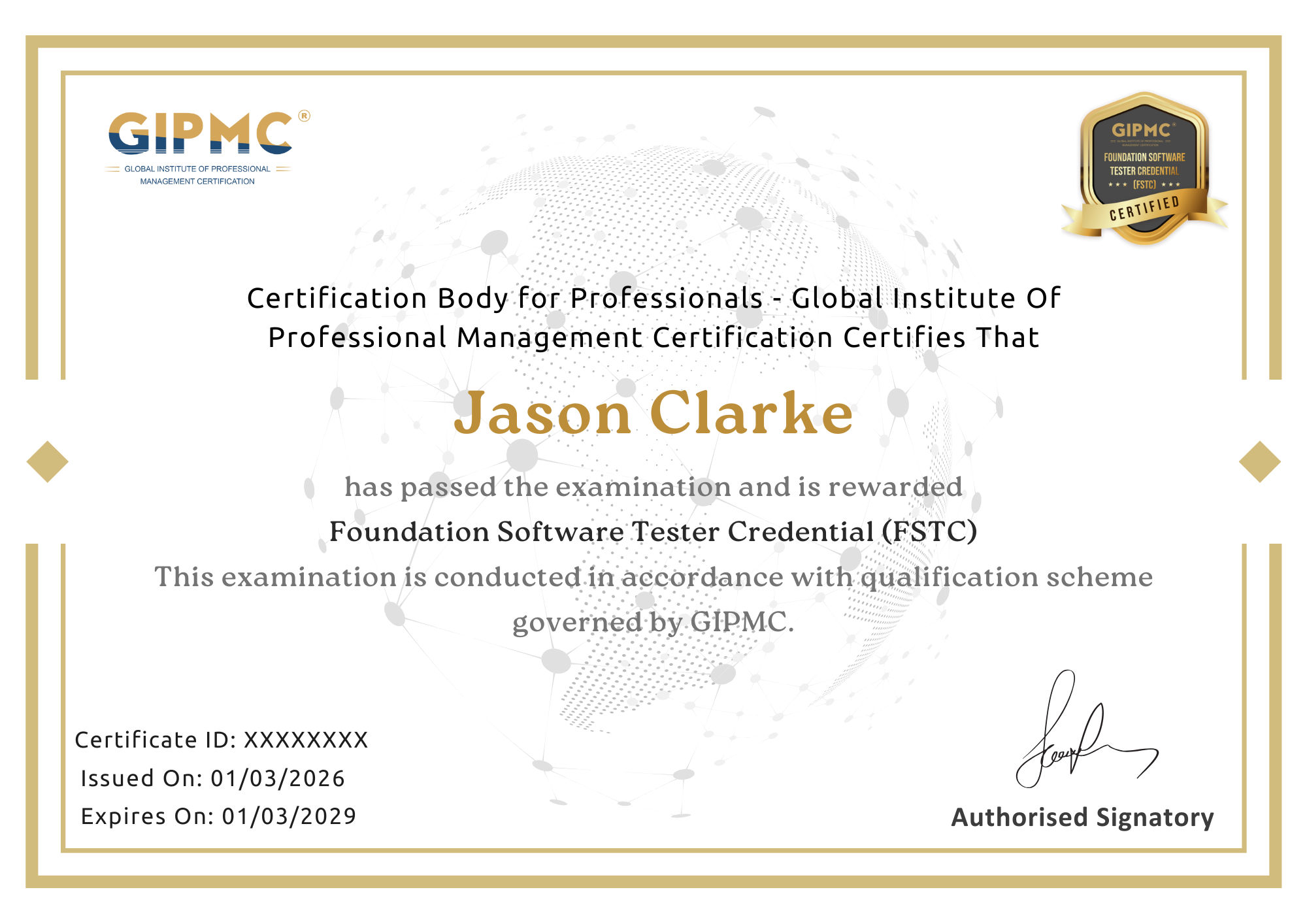
The Foundation Software Tester Credential (FSTC) is valid for three (3) years from the date of award.
Renewal Objectives
- Maintain alignment with evolving testing practices
- Reinforce foundational quality and testing knowledge
- Preserve long-term credential relevance
Renewal Requirements
- Completion of approved professional development or testing knowledge refresh activities
- Successful renewal assessment or verification, as applicable
- Submission of renewal application before credential expiry
Timely renewal allows professionals to retain active certification status without interruption.