Course Description
Anticipate Risk, Manage Crises & Strengthen Organizational Resilience
The Risk & Crisis Management Specialist (RCMS) certification is a professional credential designed to develop, validate, and recognize specialized capabilities in identifying, assessing, mitigating, and responding to organizational risks and crisis situations.
This certification emphasizes risk intelligence, crisis preparedness, response coordination, business continuity, and recovery planning, preparing professionals to protect organizations from disruption, reputational damage, and operational failure.
RCMS goes beyond theoretical risk concepts. It equips specialists with the ability to anticipate threats, manage high-pressure crisis events, coordinate stakeholders, and support resilient decision-making before, during, and after crises.
Why Best Risk & Crisis Management Specialist (RCMS) Certification - CRMA Aligned from GIPMC?
The RCMS certification is industry-neutral and scenario-driven, enabling professionals to apply risk and crisis management principles across different sectors, organizational sizes, and threat landscapes.
Key Advantages
- Globally relevant risk and crisis management framework
- Balanced coverage of prevention, preparedness, response, and recovery
- Practical, scenario-based learning aligned with real crisis events
- Applicable across industries including finance, healthcare, energy, technology, government, and services
- Career-oriented certification focused on resilience and continuity
RCMS supports professionals operating at specialist and senior operational levels in risk and crisis functions.
Market Relevance
Organizations increasingly face complex risks including operational disruption, cyber threats, regulatory pressure, and reputational crises.
- 40–60% reduction in crisis impact severity through structured risk and crisis planning
- 70%+ hiring preference for professionals with formal risk and crisis management credentials
- 45% improvement in response speed during high-impact incidents
- 2× faster recovery time for organizations with trained crisis specialists
(Based on aggregated enterprise risk management, crisis response, and business continuity benchmarks.)
These indicators highlight why risk and crisis management capability is now a core organizational requirement.
Who Should Pursue RCMS? (Target Audience)
The Risk & Crisis Management Specialist certification is designed for professionals responsible for managing uncertainty, threats, and emergency situations, including:
- Risk Management and ERM Professionals
- Business Continuity and Resilience Specialists
- Crisis Management and Emergency Response Teams
- Compliance, Governance, and Control Professionals
- Security, Safety, and Operations Managers
- Project, Program, and Operations Leaders
- Professionals transitioning into risk-focused roles
RCMS establishes a common professional framework for managing risk and crises across organizations.
Detailed Learning Outcomes
By earning the Best Risk & Crisis Management Specialist (RCMS) Certification - CRMA Aligned, candidates demonstrate competencies consistent with a CAPM project management certification, including the ability to:
1. Foundations of Risk & Crisis Management
- Understanding risk, uncertainty, and crisis concepts
- Difference between risk management and crisis management
- Specialist roles and responsibilities
2. Risk Identification & Threat Analysis
- Identifying internal and external risks
- Strategic, operational, financial, and reputational threats
- Emerging and systemic risk awareness
3. Risk Assessment & Prioritization
- Risk evaluation methodologies
- Likelihood and impact assessment
- Risk ranking and decision support
4. Risk Mitigation & Control Strategies
- Preventive and detective controls
- Risk treatment options
- Monitoring and control effectiveness
5. Crisis Preparedness & Scenario Planning
- Crisis readiness and preparedness planning
- Scenario development and stress testing
- Early warning indicators
6. Crisis Response Frameworks & Protocols
- Incident and crisis response structures
- Decision-making under pressure
- Command, control, and coordination
7. Communication & Stakeholder Management in Crises
- Internal and external crisis communication
- Media, public, and stakeholder engagement
- Managing misinformation and escalation
8. Business Continuity & Operational Resilience
- Business continuity planning fundamentals
- Critical process and resource protection
- Maintaining operations during disruption
9. Technology, Cyber & Digital Risk Awareness
- Technology-enabled risks and cyber threats
- Crisis implications of digital failures
- Coordination with technical response teams
10. Legal, Regulatory & Compliance Considerations
- Regulatory obligations during crises
- Legal risk management
- Documentation and reporting requirements
11. Post-Crisis Recovery & Lessons Learned
- Recovery planning and stabilization
- Root cause analysis and improvement actions
- Organizational learning after crises
12. Ethics, Leadership & Human Factors in Crises
- Ethical decision-making under pressure
- Leadership behavior and human impact
- Stress, judgment, and team dynamics
13. Risk & Crisis Capstone & Simulation Review
- End-to-end risk and crisis management scenario
- Response evaluation and recommendations
- Final professional assessment and resilience roadmap
Professional and Career Benefits
RCMS certified professionals are recognized for their ability to:
- Identify and manage organizational risks proactively
- Lead and support effective crisis response efforts
- Reduce disruption and protect organizational value
- Strengthen resilience and continuity capabilities
- Support leadership during high-impact events
Career roles supported by RCMS include:
- Risk & Crisis Management Specialist
- Enterprise Risk Analyst
- Business Continuity & Resilience Manager
- Crisis Response and Emergency Management Professional
- Governance, Risk & Compliance (GRC) Specialist
- Operational Risk Manager
Certification Validity & Renewal
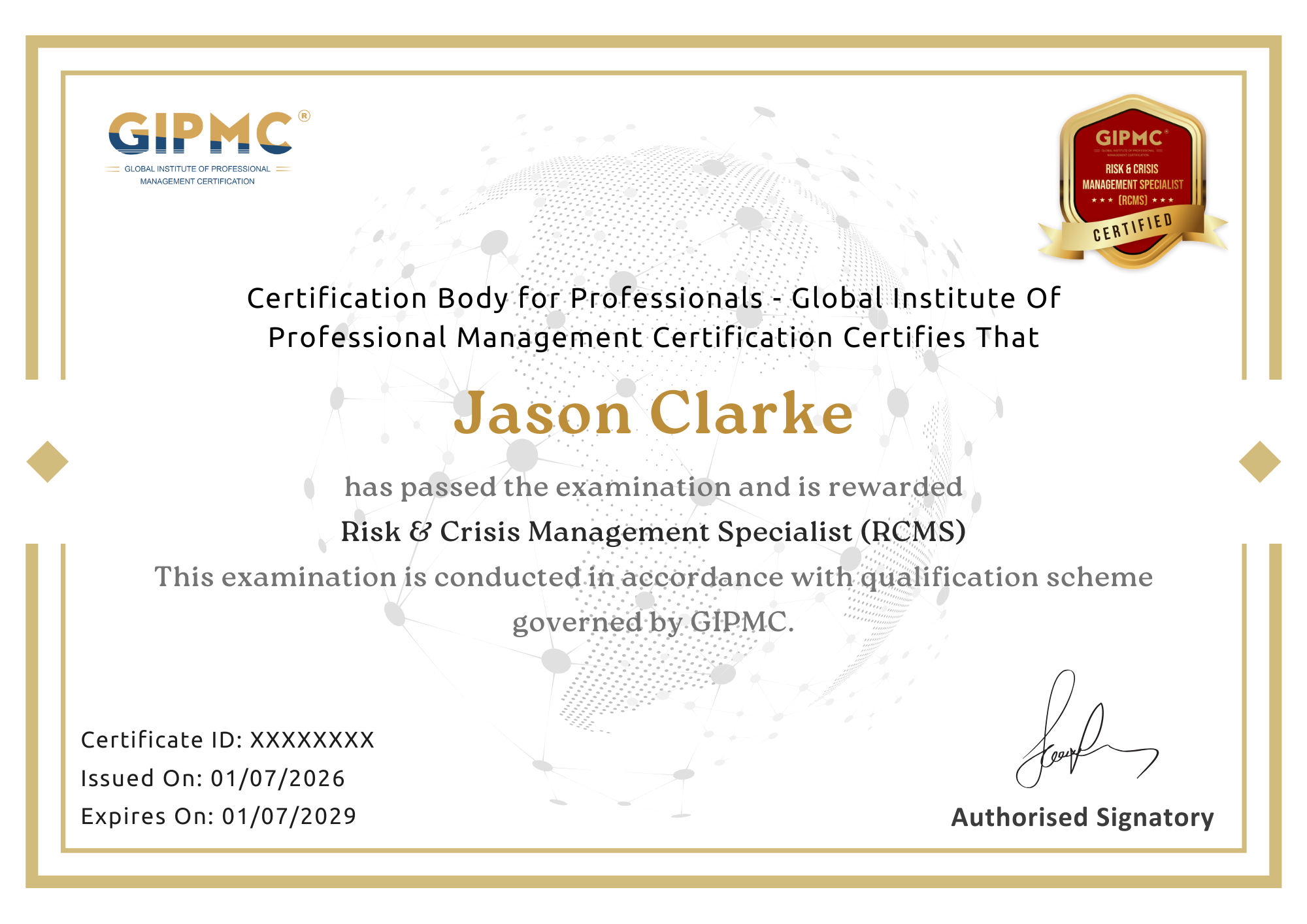
The Risk & Crisis Management Specialist (RCMS) certification is valid for three (3) years from the date of certification award.
Renewal Purpose
- Maintain alignment with evolving risk landscapes and crisis practices
- Reinforce preparedness, response, and resilience competencies
- Protect the long-term professional credibility of the certification
Renewal Process Includes
- Completion of defined professional development or risk and crisis knowledge refresh activities
- Successful renewal assessment or verification, as applicable
- Submission of renewal application prior to certification expiry
Timely renewal allows professionals to retain active certification status without interruption.