Course Description
Drive Cost Intelligence, Control, and Strategic Value Creation
The Cost Accounting Leader (CAL) certification is a professional credential designed to develop and validate advanced expertise in cost accounting, cost control, and cost-based decision support. It equips professionals with the analytical, managerial, and strategic capabilities required to lead cost management initiatives, support pricing and investment decisions, and enhance organizational profitability.
CAL focuses on strategic cost leadership, enabling professionals to move beyond traditional cost tracking and contribute to value creation through informed cost analysis, optimization, and governance.
Why Cost Accounting Leader (CAL) from GIPMC?
The CAL certification is built to be globally relevant, standards-aware, and framework-neutral, allowing professionals to apply cost accounting principles across industries, organizational models, and accounting environments without dependency on a single methodology.
Key Advantages
- Globally applicable cost accounting leadership framework
- Strong focus on cost strategy, control, and decision support
- Balanced coverage of analysis, management, and governance
- Practical, scenario-driven learning approach
- Career-oriented credential for finance and accounting leaders
CAL supports professionals responsible for shaping cost management practices and leading cost-focused decision-making.
Market Relevance
- Effective cost leadership improves profitability and competitiveness
- Organizations value leaders who can translate cost data into strategic insight
- Structured cost management reduces waste and margin erosion
- Demand for cost accounting and financial performance leaders remains strong
(Based on aggregated finance, accounting, and cost management trends.)
As organizations face margin pressure and cost complexity, advanced cost accounting leadership is increasingly critical.
Who Should Pursue CAL? (Target Audience)
The Cost Accounting Leader (CAL) certification is suitable for professionals involved in cost management, financial analysis, and performance leadership, including:
- Cost Accountants and Management Accountants
- Finance and Controlling Managers
- FP&A and Financial Analysis Professionals
- Operations and Production Finance Leaders
- Business Unit Finance Heads
- Consultants in cost and performance management
- Professionals transitioning into senior cost leadership roles
CAL provides a structured pathway to advanced cost accounting leadership across industries.
Detailed Learning Outcomes
By earning the Cost Accounting Leader (CAL), candidates demonstrate competencies consistent with a CAPM project management certification, including the the ability to:
1. Foundations of Cost Accounting & Management
- Role of cost accounting in business decision-making
- Cost concepts, classifications, and behaviors
- Cost accounting systems and objectives
2. Cost Structures & Cost Behavior Analysis
- Fixed, variable, and mixed costs
- Cost drivers and cost dynamics
- Analyzing cost patterns and trends
3. Costing Methods & Applications
- Job, process, and activity-based costing concepts
- Selecting appropriate costing approaches
- Applying costing methods to real-world scenarios
4. Budgeting, Forecasting & Cost Planning
- Cost budgeting techniques
- Forecasting and variance analysis
- Linking budgets to operational plans
5. Cost Control & Performance Measurement
- Establishing cost control mechanisms
- Standard costing and variance interpretation
- Cost-related KPIs and performance metrics
6. Cost Analysis for Pricing & Profitability
- Cost-based pricing considerations
- Product, customer, and channel profitability analysis
- Break-even and contribution analysis
7. Strategic Cost Management
- Cost leadership and differentiation strategies
- Value chain and lifecycle costing
- Cost optimization and efficiency initiatives
8. Operational Cost Management
- Managing production and service costs
- Capacity and utilization analysis
- Cost management in operations and supply chains
9. Cost Information for Decision-Making
- Relevant cost analysis for decisions
- Make-or-buy, outsourcing, and investment decisions
- Risk and sensitivity analysis
10. Cost Governance, Controls & Ethics
- Internal controls in cost accounting
- Ethical considerations and compliance
- Audit and assurance perspectives
11. Digital Tools & Cost Analytics
- Cost accounting systems and automation
- Data analytics for cost insights
- Technology-enabled cost management
12. Leadership in Cost Management
- Leading cost improvement initiatives
- Cross-functional collaboration
- Communicating cost insights to stakeholders
13. Continuous Improvement & Cost Maturity
- Reviewing and improving cost systems
- Building cost-conscious culture
- Advancing organizational cost maturity
Professional and Career Benefits
CAL certified professionals are recognized for their ability to:
- Lead cost accounting and control functions
- Translate cost data into strategic insights
- Improve profitability through informed cost management
- Support pricing, investment, and performance decisions
- Strengthen cost governance and accountability
Career Opportunities Include:
- Cost Accounting Leader or Manager
- Finance or Controlling Manager
- FP&A or Performance Management Leader
- Operations Finance Head
- Cost and Profitability Consultant
- Senior Management Accountant
Certification Validity & Renewal
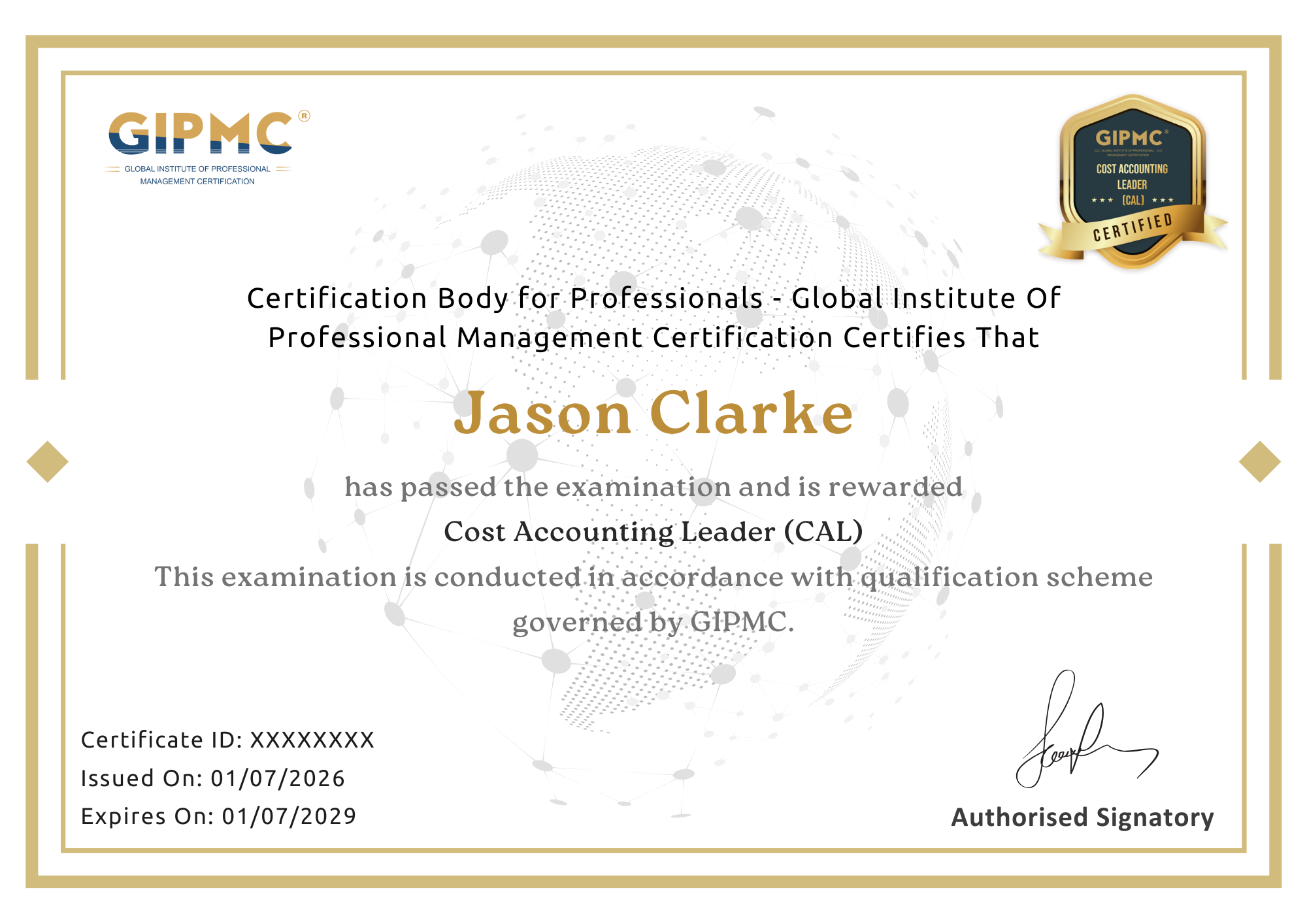
The Cost Accounting Leader (CAL) certification is valid for three (3) years from the date of certification award.
Renewal Objectives
- Maintain relevance in evolving cost management practices
- Stay aligned with financial reporting and performance standards
- Preserve the long-term value of the certification
Renewal Requirements Include:
- Completion of defined continuing professional development activities
- Successful renewal assessment or competency validation, as applicable
- Submission of renewal application prior to certification expiry
Timely renewal allows professionals to retain active certification status without interruption.