Course Description
The Identity & Access Governance Analyst (IAGA) certification is a professional credential designed to develop, validate, and recognize expertise in identity governance, access control, and authorization risk management across enterprise environments.
IAGA prepares professionals to analyze, implement, and support identity and access governance programs that ensure the right users have the right access at the right time for the right reasons. The certification emphasizes governance, compliance, and audit readiness, enabling organizations to reduce security risk while supporting operational efficiency.
IAGA goes beyond technical access provisioning. It equips professionals with the skills to manage identity lifecycle governance, policy enforcement,
Why Identity & Access Governance Analyst (IAGA) from GIPMC?
IAGA is built on enterprise identity governance and access management best practices, remaining vendor-neutral and framework-aligned. This allows certified professionals to apply governance principles across diverse IAM platforms and organizational models.
Key Advantages
- Enterprise-focused identity governance framework
- Emphasis on access risk, compliance, and auditability
- Coverage of identity lifecycle, entitlements, and access reviews
- Applicable across industries including finance, healthcare, technology, government, and regulated sectors
- Career-oriented credential aligned with IAM governance and security assurance roles
IAGA supports professionals responsible for governing digital identities and access
Market Relevance
- Identity-related issues contribute to 80–90% of cybersecurity breaches
- Over-privileged access accounts for 35–45% of internal security incidents
- Organizations with mature identity governance reduce access-related risk by 30–50%
- 70%+ enterprises identify IAM governance as a top security and compliance priority
- Automated access governance reduces audit preparation effort by 40–60%
(Based on aggregated enterprise security, identity governance, and compliance trends.)
These figures highlight why identity and access governance expertise is critical to modern cybersecurity.
Who Should Pursue IAGA? (Target Audience)
The IAGA certification is suitable for professionals involved in identity, security governance, and access control, including:
- Identity & Access Management (IAM) Analysts
- Security Governance, Risk, and Compliance (GRC) Professionals
- IT Security and Infrastructure Analysts
- Risk, Audit, and Compliance Support Staff
- Cybersecurity Analysts focusing on identity controls
- IT Operations professionals with access oversight responsibilities
- • Professionals transitioning into IAM governance roles
IAGA provides a structured governance lens for managing enterprise identities.
Detailed Learning Outcomes
By earning the Identity & Access Governance Analyst (IAGA), candidates demonstrate competencies consistent with a CAPM project management certification, including the the ability to:
1. Foundations of Identity & Access Governance
- Role of identity governance in enterprise security
- Difference between IAM operations and governance
- Principles of least privilege and access accountability
2. Identity Lifecycle Management
- Joiner, mover, and leaver processes
- Identity provisioning and deprovisioning governance
- Managing identity attributes and roles
3. Access Control Models & Entitlements
- Role-based and attribute-based access control
- Entitlement structures and ownership
- Managing privileged and sensitive access
4. Access Policy & Governance Frameworks
- Defining access policies and standards
- Approval workflows and segregation of duties
- Policy enforcement and exceptions
5. Access Reviews & Certifications
- Periodic access reviews and attestations
- Reviewer roles and accountability
- Managing review outcomes and remediation
6. Risk Analysis & Segregation of Duties (SoD)
- Identifying toxic access combinations
- Risk scoring and prioritization
- Preventing fraud and misuse
7. Privileged Access Governance
- Governing elevated and administrative access
- Temporary access and just-in-time concepts
- Monitoring and accountability
8. Identity Data Quality & Controls
- Managing identity data accuracy
- Handling orphaned and dormant accounts
- Continuous data validation
9. Compliance & Regulatory Alignment
- Supporting regulatory and audit requirements
- Evidence collection and reporting
- Audit readiness and traceability
10. Identity Governance Automation
- Automating access workflows
- Policy-driven access decisions
- Reducing manual governance effort
11. Monitoring, Metrics & Reporting
- Governance KPIs and risk indicators
- Dashboards and executive reporting
- Measuring governance effectiveness
12. Incident Support & Remediation
- Responding to access violations
- Coordinating remediation actions
- Lessons learned and control improvement
13. Continuous Improvement & Maturity
- Assessing identity governance maturity
- Enhancing controls over time
- Aligning with evolving enterprise risk
Professional and Career Benefits
IAGA-certified professionals are recognized for their ability to:
- Govern identity and access risk effectively
- Improve compliance and audit readiness
- Reduce over-privileged and unauthorized access
- Strengthen enterprise security posture
- Bridge security, IT, and compliance functions
The certification supports career progression into roles such as:
- Identity & Access Governance Analyst
- IAM Security Analyst
- Access Risk and Compliance Analyst
- Security GRC Analyst (Identity Focus)
- Identity Governance Consultant
Certification Validity & Renewal
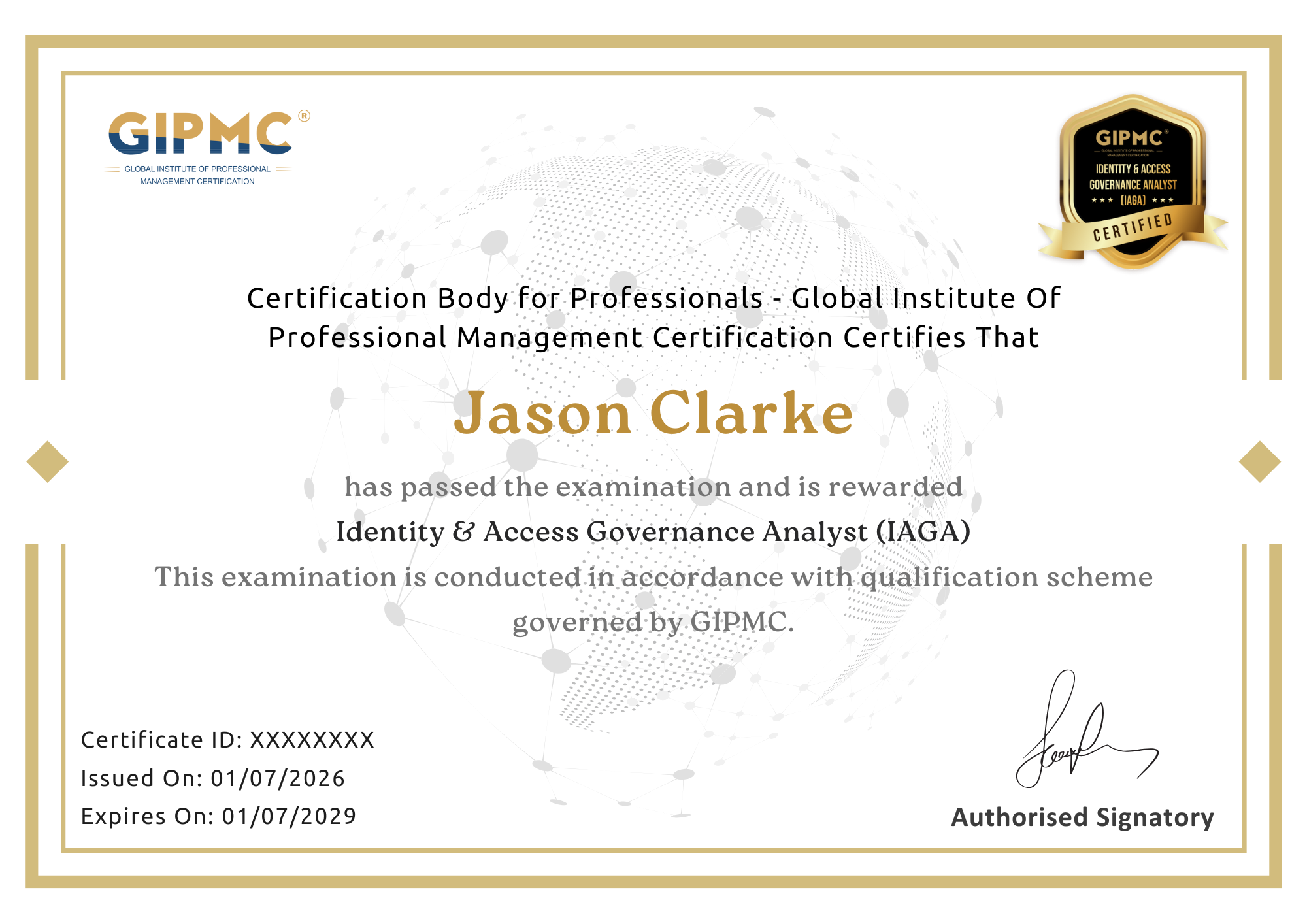
The Identity & Access Governance Analyst (IAGA) certification is valid for three (3) years from the date of award.
Renewal Objectives
- Maintain relevance with evolving identity governance practices
- Reinforce access risk and compliance expertise
- Protect long-term credential
Renewal Requirements
- Completion of approved professional development or IAM governance knowledge refresh activities
- Successful renewal assessment or verification, as applicable
- •Submission of renewal application prior to certification expiry
Timely renewal allows professionals to retain active certification status without interruption.