Course Description
The ISO 22000:2018 Lead Auditor Certification is a professional credential designed to develop, validate, and recognize expert-level competence in auditing Food Safety Management Systems (FSMS) in accordance with ISO 22000:2018.
This certification prepares professionals to plan, conduct, lead, and report first-party, second-party, and third-party audits that assess conformity, effectiveness, and continual improvement of food safety management systems across the food chain. It emphasizes hazard-based thinking, risk management, prerequisite programs (PRPs), HACCP principles, regulatory compliance, and leadership accountability.
This certification goes beyond clause interpretation by equipping professionals with the audit leadership capability, food safety risk insight, and professional
Why ISO 22000 Certification for Lead Auditors (ISO 22000:2018) from GIPMC?
Food safety failures can result in severe public health risks, regulatory penalties, and reputational damage. This certification is globally recognized, regulator-aligned, and food-chain–wide, enabling auditors to operate confidently across agriculture, food processing, packaging, logistics, catering, retail, and food service sectors.
Key Advantages
- Globally recognized ISO 22000:2018 Lead Auditor credential
- Strong alignment with international food safety regulations and Codex principles
- Risk-based and process-oriented audit approach
- Applicable across the entire food supply chain
- Career-oriented certification with strong food safety credibility
This certification supports professionals at the senior audit, food safety, and compliance leadership level.
Market Relevance
As global food supply chains expand and regulatory oversight increases, demand for qualified ISO 22000 Lead Auditors continues to grow.
- 75–90% of food organizations are required to implement formal FSMS frameworks
- 65–85% hiring preference for food safety and quality professionals with ISO 22000 audit credentials
- 30–55% reduction in food safety nonconformities and incidents through structured FSMS audits
- 2x higher certification audit success and regulatory confidence when audits are led by certified lead auditors
(Based on aggregated global food safety regulation enforcement, certification adoption, and supply chain risk trends.)
These figures demonstrate why ISO 22000 Lead Auditor capability is critical to public health protection and food business continuity.
Who Should Pursue ISO 22000:2018 Lead Auditor Certification? (Target Audience)
The ISO 22000:2018 Lead Auditor Certification is suitable for professionals involved in food safety, quality, and audit activities, including:
- ISO 22000 Lead Auditors and External Auditors
- Food Safety and Quality Managers
- HACCP and FSMS Coordinators
- Risk, Compliance, and Regulatory Professionals
- Internal Auditors and Audit Program Managers
- Consultants supporting food safety certification
- Professionals responsible for food safety governance
Across the food sector, this certification provides a structured framework for leading effective food safety audits.
Detailed Learning Outcomes
By earning the ISO 22000 Certification for Lead Auditors (ISO 22000:2018), candidates demonstrate competencies consistent with a CAPM project management certification, including the the ability to:
1. Fundamentals of ISO 22000 and Food Safety Management
- Purpose and scope of ISO 22000:2018
- Principles of food safety management
- Role of FSMS in protecting consumers
2. Food Safety Regulatory and Industry Context
- Global food safety regulations and expectations
- Codex Alimentarius alignment
- Audit considerations for regulatory compliance
3. Structure and Requirements of ISO 22000:2018
- Clause-by-clause understanding
- Context of the organization and leadership
- Food safety policy and objectives
4. Hazard Analysis and Risk-Based Thinking
- Biological, chemical, and physical hazards
- Risk assessment and control selection
- Auditing hazard analysis effectiveness
5. Prerequisite Programs (PRPs) and Operational PRPs
- Hygiene, sanitation, and environmental controls
- Infrastructure and operational requirements
- Auditing PRP implementation
6. HACCP Principles and Control Measures
- Critical control points (CCPs)
- Monitoring, verification, and validation
- Auditing HACCP system effectiveness
7. Audit Planning and Preparation
- Defining audit scope, objectives, and criteria
- Developing audit plans and checklists
- Managing audit resources
8. Conducting ISO 22000 Audits
- Opening meetings and audit execution
- Interviewing food safety and operational staff
- Collecting objective audit evidence
9. Operational Control and Food Defense
- Auditing process controls and traceability
- Food fraud and food defense awareness
- Managing emergency preparedness
10. Identifying and Writing Nonconformities
- Objective evidence and audit findings
- Classifying nonconformities
- Assessing food safety impact
11. Audit Reporting and Corrective Actions
- Preparing professional audit reports
- Communicating audit conclusions
- Verifying corrective action effectiveness
12. Leading Audit Teams and Professional Conduct
- Managing and coordinating audit teams
- Ensuring auditor competence and impartiality
- Handling sensitive food safety information
13. Audit Program Management and Continual Improvement
- Managing FSMS audit programs
- Using audits to improve food safety performance
- Supporting certification and surveillance audits
Professional and Career Benefits
ISO 22000:2018 Lead Auditor certified professionals are recognized for their ability to:
- Lead high-impact food safety management system audits
- Improve food safety compliance and risk control
- Reduce foodborne incidents and recalls
- Strengthen regulatory and customer confidence
- Support certification and regulatory assurance initiatives
The certification supports career advancement into roles such as:
- ISO 22000 Lead Auditor
- Food Safety or Quality Manager
- FSMS and HACCP Consultant
- Compliance and Regulatory Manager
- Internal or External Food Safety Auditor
- Certification Body or Third-Party Auditor
Certification Validity & Renewal
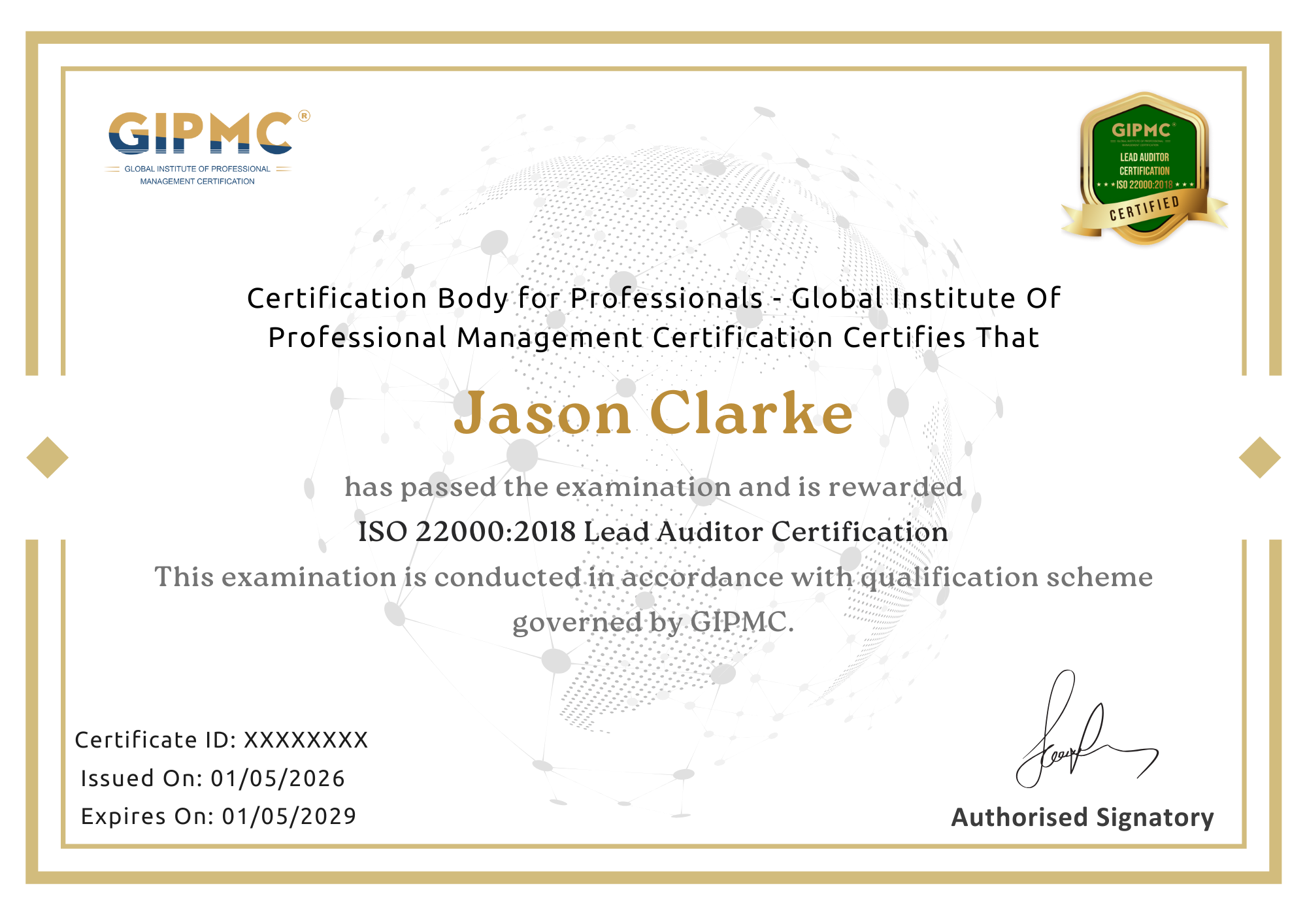
The ISO 22000:2018 Lead Auditor Certification is valid for three (3) years from the date of certification award.
Renewal is designed to:
- Maintain professional credibility
- Ensure continued alignment with evolving food safety practices
- Protect the long-term value of the certification
Timely renewal allows professionals to retain active certification status without interruption.