Course Description
The Professional Scrum Leadership Expert (PSLE) certification is a professional credential designed to develop, validate, and recognize advanced capability in leading Scrum and Agile teams, products, and organizations to deliver value in complex and fast-changing environments.
This certification prepares professionals to operate beyond Scrum mechanics by focusing on leadership behaviors, organizational agility, culture, governance, and value-driven delivery. It emphasizes servant leadership, Agile decision-making, stakeholder alignment, Scrum at scale awareness, and sustainable performance.
PSLE goes beyond the role of Scrum Master or Product Owner by equipping professionals with the leadership mindset and enterprise perspective required to embed Scrum principles across teams, products, and organizations.
Why Professional Scrum Leadership Expert (PSLE) from GIPMC?
Organizations adopting Scrum often struggle not with frameworks, but with leadership, culture, and mindset transformation. PSLE is framework-aware, role-agnostic, and leadership-focused, enabling professionals to apply Scrum leadership principles across Agile, hybrid, and enterprise environments.
Key Advantages
- Leadership-focused Scrum and Agile credential
- Strong emphasis on culture, mindset, and value delivery
- Applicable beyond team level to enterprise leadership
- Integrates governance, strategy, and Agile execution
- Career-oriented certification with real-world leadership relevance
PSLE is designed for professionals operating at the senior Agile leadership and organizational influence level.
Market Relevance
As Agile and Scrum adoption expands globally, organizations increasingly seek leaders who can enable agility, not just manage ceremonies.
- 70–85% of organizations use Scrum or Scrum-based Agile frameworks
- 65–90% employer preference for Agile leaders with formal Scrum leadership credentials
- 30–50% improvement in team productivity and engagement under effective Scrum leadership
- 2x higher success rates in Agile transformations led by trained Scrum leaders
(Based on aggregated global Agile adoption, transformation success, and workforce demand trends.)
These figures demonstrate why Scrum leadership capability is essential for sustainable Agile success.
Who Should Pursue Professional Scrum Leadership Expert (PSLE)? (Target Audience)
The Professional Scrum Leadership Expert (PSLE) certification is suitable for professionals responsible for leading Agile teams, products, or transformations, including:
- Scrum Masters and Senior Scrum Practitioners
- Agile Coaches and Agile Leaders
- Product Owners and Product Leaders
- Engineering and Delivery Managers
- Transformation and Change Leaders
- PMO, EPMO, and Governance Professionals
- Executives and Managers leading Agile adoption
Across industries, PSLE provides a structured framework for effective Scrum-based leadership.
Detailed Learning Outcomes
By earning the Professional Scrum Leadership Expert (PSLE), candidates demonstrate competencies consistent with a CAPM project management certification, including the ability to:
1. Foundations of Scrum and Agile Leadership
- Purpose and values of Scrum
- Difference between management and leadership in Agile
- Leadership responsibilities in Scrum environments
2. Scrum Values, Principles, and Mindset
- Transparency, inspection, and adaptation
- Building trust and accountability
- Embedding Agile values into culture
3. Servant Leadership in Scrum
- Role of servant leadership
- Empowering teams and individuals
- Removing impediments at organizational level
4. Leadership Roles in Scrum Environments
- Supporting Scrum Masters and Product Owners
- Leadership interactions with teams
- Avoiding command-and-control behaviors
5. Value-Driven Product and Delivery Leadership
- Understanding value in Scrum
- Aligning backlogs with business outcomes
- Supporting outcome-focused delivery
6. Stakeholder Engagement and Organizational Alignment
- Managing stakeholder expectations
- Aligning leadership and teams
- Creating shared understanding of priorities
7. Governance and Leadership Accountability in Agile
- Agile governance principles
- Balancing autonomy and control
- Leadership accountability for outcomes
8. Enabling High-Performing Scrum Teams
- Psychological safety and collaboration
- Supporting continuous improvement
- Measuring team health and performance
9. Managing Change and Agile Transformation
- Leading Agile change initiatives
- Overcoming resistance and inertia
- Sustaining transformation momentum
10. Scaling Scrum and Organizational Agility Awareness
- Challenges of scaling Scrum
- Leadership considerations for multiple teams
- Supporting alignment and coordination
11. Metrics, Evidence, and Agile Decision-Making
- Using empirical data for decisions
- Avoiding misuse of metrics
- Supporting transparency and learning
12. Ethical Leadership and Professional Conduct
- Integrity and respect in Agile leadership
- Handling conflict and difficult situations
- Role-modeling Scrum values
13. Professional Practice and Scrum Leadership Maturity
- Assessing leadership maturity
- Continuous learning and improvement
- Preparing for enterprise Agile leadership roles
Professional and Career Benefits
Professional Scrum Leadership Expert (PSLE) certified professionals are recognized for their ability to:
- Lead Scrum and Agile environments effectively
- Enable high-performing, self-managing teams
- Improve value delivery and stakeholder confidence
- Support sustainable Agile transformations
- Align Agile execution with organizational strategy
The certification supports career advancement into roles such as:
- Professional Scrum Leadership Expert
- Senior Scrum Master or Agile Coach
- Agile Delivery or Transformation Leader
- Product and Delivery Leadership Roles
- Enterprise Agile or Change Leader
- Executive and Governance Roles in Agile Organizations
Certification Validity & Renewal
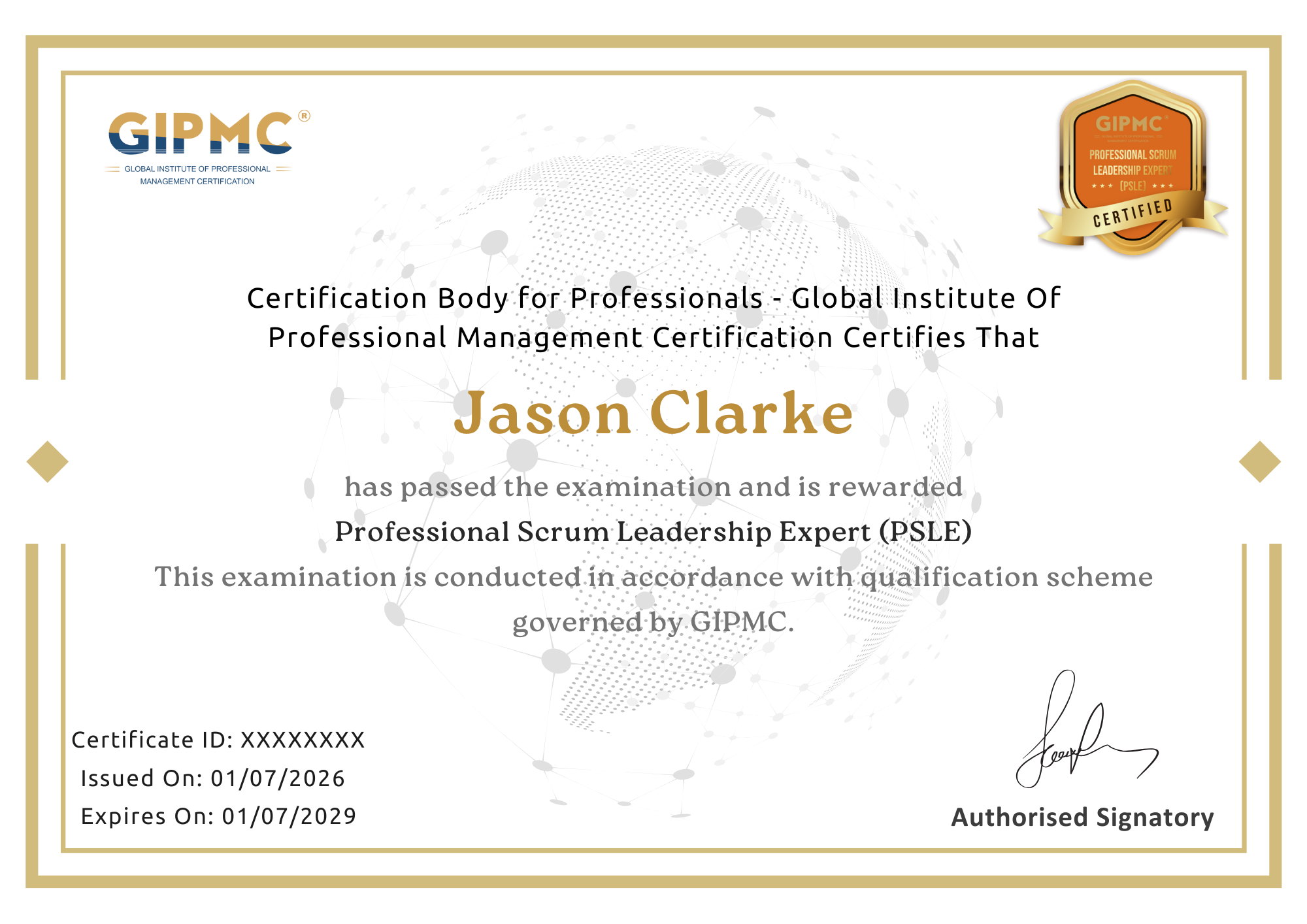
The Professional Scrum Leadership Expert (PSLE) certification is valid for three (3) years from the date of certification award.
Renewal is designed to:
- Maintain professional credibility
- Ensure continued alignment with evolving Scrum and Agile leadership practices
- Protect the long-term value of the certification
Renewal Process Includes:
- Completion of defined continuing professional development or knowledge refresh requirements
- Successful renewal assessment or verification, as applicable
- Submission of renewal application before certification expiry
Timely renewal allows professionals to retain active certification status without interruption.