Course Description
Build Ethical Awareness, Accountability & Trust in AI Systems
The Responsible AI & Ethics Foundation (RAIEF) certification is a foundational professional credential designed to develop, validate, and recognize core knowledge and awareness of ethical, responsible, and trustworthy AI practices.
This certification emphasizes ethical principles, fairness, transparency, accountability, risk awareness, and human-centered AI use, preparing professionals to interact with AI systems responsibly across personal, organizational, and societal contexts.
RAIEF establishes ethical literacy before technical depth. It equips learners with the ability to identify ethical risks, apply responsible AI principles, and support trustworthy AI adoption, regardless of technical background.
Why Responsible AI & Ethics Foundation (RAIEF) from GIPMC?
The RAIEF certification is role-agnostic and technology-neutral, ensuring relevance across industries, job functions, and AI maturity levels.
Key Advantages
- Globally relevant responsible AI and ethics framework
- Clear focus on ethical awareness, governance, and human impact
- Practical, scenario-based learning grounded in real-world AI use
- Applicable across business, technology, education, public sector, and research environments
- Foundational certification supporting long-term AI literacy and trust
RAIEF supports learners at the foundation and awareness level of responsible AI adoption.
Market Relevance
As AI adoption accelerates, organizations increasingly prioritize ethical, transparent, and accountable AI use.
- 50–65% reduction in ethical AI risks through structured awareness and governance
- 70%+ organizational preference for professionals trained in responsible AI principles
- 45% improvement in AI trust and acceptance among users and stakeholders
- 2× faster compliance readiness for AI governance and regulatory expectations
(Based on aggregated AI governance, ethics adoption, and organizational risk management benchmarks.)
These indicators show why responsible AI awareness is becoming a baseline professional requirement.
Who Should Pursue RAIEF? (Target Audience)
The Responsible AI & Ethics Foundation certification is suitable for individuals who use, manage, influence, or are impacted by AI systems, including:
- Business professionals and decision-makers
- Technology and data practitioners
- AI product and project team members
- Policy, compliance, and risk professionals
- Educators, researchers, and students
- HR, legal, and governance teams
- Anyone seeking ethical AI awareness
RAIEF provides a common ethical language for responsible AI engagement across roles.
Detailed Learning Outcomes
By earning the Responsible AI & Ethics Foundation (RAIEF), candidates demonstrate competencies consistent with a CAPM project management certification, including the the ability to:
1. Foundations of Responsible AI
- What responsible AI means
- Why ethics matter in AI systems
- Human-centered AI principles
2. AI Systems & Societal Impact
- How AI affects individuals and society
- Opportunities and risks of AI adoption
- Social, economic, and cultural considerations
3. Ethical Principles in AI
- Fairness, accountability, and transparency
- Explainability and human oversight
- Balancing innovation and responsibility
4. Bias, Fairness & Inclusion
- Understanding bias in AI systems
- Sources of data and algorithmic bias
- Strategies to reduce unfair outcomes
5. Data Ethics & Privacy Awareness
- Ethical data collection and use
- Privacy, consent, and data protection
- Responsible data stewardship
6. Accountability & Governance Basics
- Who is responsible for AI decisions
- Governance roles and structures
- Escalation and accountability mechanisms
7. Transparency & Explainability
- Importance of explainable AI
- Communicating AI decisions to users
- Building trust through transparency
8. Risk Identification & Ethical Assessment
- Identifying ethical and social risks
- Risk categorization and prioritization
- Preventive and mitigation approaches
9. Responsible AI in the Workplace
- Ethical AI use in business operations
- Human-AI collaboration boundaries
- Managing misuse and over-reliance
10. Regulations, Standards & Guidelines Awareness
- Overview of AI-related regulations
- Global standards and ethical guidelines
- Organizational compliance readiness
11. Ethical Decision-Making Frameworks
- Structured approaches to ethical dilemmas
- Balancing competing interests
- Responsible decision-making practices
12. Culture, Awareness & Ethical Leadership
- Building an ethical AI culture
- Awareness, training, and communication
- Role of leadership in responsible AI
13. Responsible AI Capstone & Reflection
- Applying responsible AI principles to real scenarios
- Ethical assessment and recommendations
- Final review and knowledge validation
Professional and Career Benefits
RAIEF-certified professionals are recognized for their ability to:
- Understand ethical implications of AI systems
- Identify and mitigate responsible AI risks
- Support trustworthy and transparent AI use
- Contribute to ethical governance and compliance efforts
- Engage confidently in AI-related discussions
RAIEF supports roles and pathways such as:
- Responsible AI Awareness Practitioner
- AI Ethics & Governance Support Roles
- AI Product and Policy Team Member
- Compliance and Risk Support Functions
- Foundation-level AI literacy programs
Certification Validity & Renewal
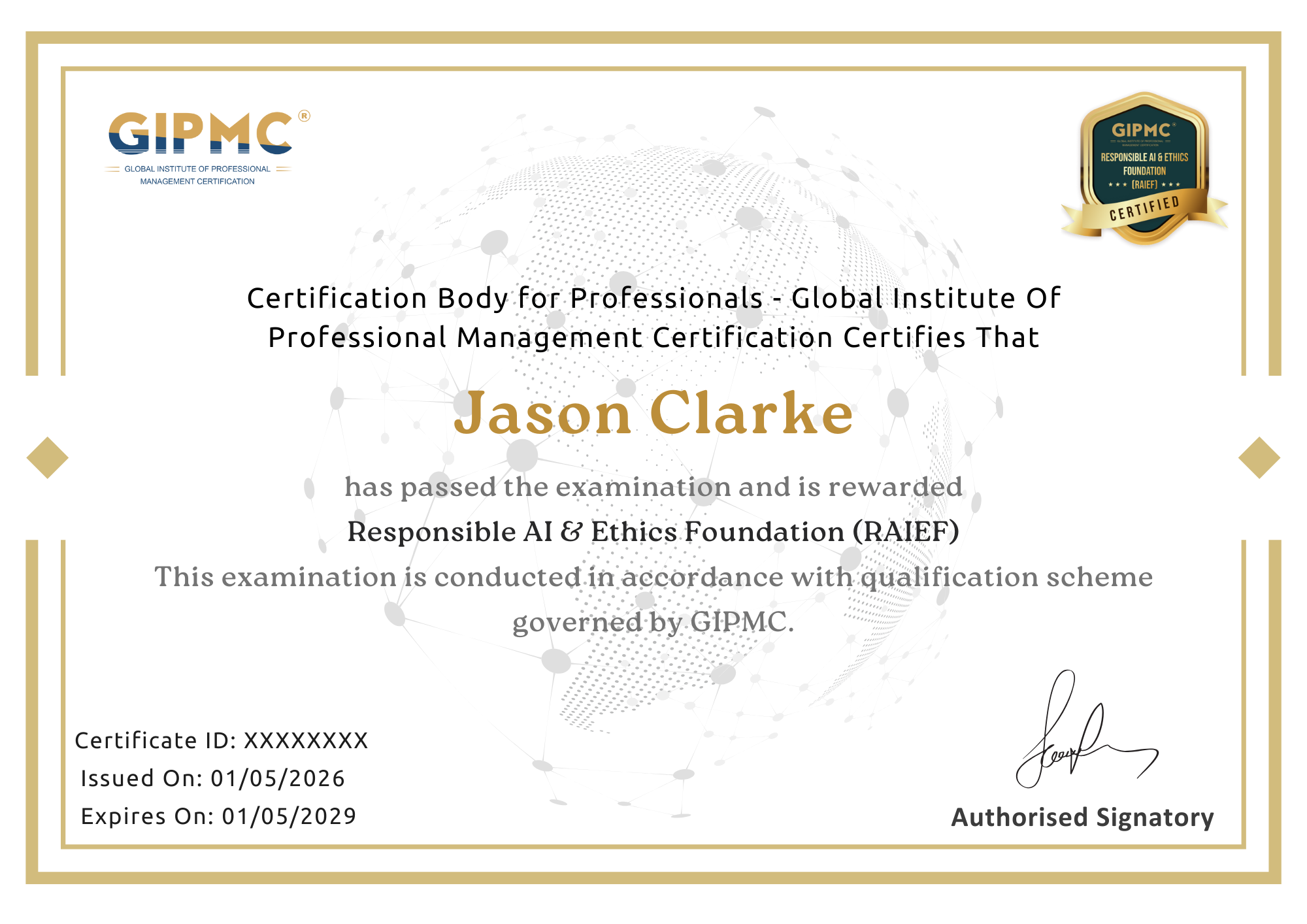
The Responsible AI & Ethics Foundation (RAIEF) certification is valid for three (3) years from the date of certification award.
Renewal Purpose
- Maintain alignment with evolving AI ethics standards and regulations
- Reinforce responsible AI awareness and governance principles
- Preserve long-term professional and organizational trust
Renewal Process Includes
- Completion of defined ethics or responsible AI knowledge refresh activities
- Successful renewal assessment or verification, as applicable
- Submission of renewal application prior to certification expiry
Timely renewal allows professionals to retain active certification status without interruption.