Course Description
Advancing Software Testing Skills for Reliable, High-Quality Software Delivery
The Intermediate Software Tester Certification (ISTC) is a professional credential designed to develop, validate, and recognize intermediate-level software testing knowledge, analytical skills, and quality assurance practices.
ISTC prepares professionals to perform structured test design, execution, analysis, and coordination across modern software development environments. The certification emphasizes risk-based testing, defect prevention, and collaboration, enabling organizations to improve software quality and release confidence.
ISTC bridges the gap between foundational testing knowledge and advanced testing leadership or specialization roles.
Why Intermediate Software Tester Certification (ISTC) from GIPMC?
ISTC is built on industry-aligned software testing principles, remaining methodology-neutral and tool-agnostic. This allows certified professionals to apply testing expertise across waterfall, agile, DevOps, and hybrid delivery models.
Key Advantages
ISTC supports professionals seeking to strengthen their testing capability and career growth.
Market Relevance
- Software defects cause 30–50% of project rework costs
- Defects detected post-release cost 5–7× more to fix than early detection
- Organizations with mature testing practices reduce production defects by 35–50%
- 70%+ of software teams require testers with intermediate or advanced testing skills
- Skilled testers improve release stability and reduce incidents by 25–40%
(Based on aggregated software quality, delivery performance, and testing maturity trends.)
These figures highlight the strong demand for intermediate-level software testing expertise.
Who Should Pursue ISTC? (Target Audience)
The ISTC certification is suitable for professionals with foundational testing experience, including:
- Software Testers and QA Analysts
- Manual Test Engineers
- Automation Testers expanding test design skills
- Business Analysts involved in testing activities
- Developers performing testing roles
- QA professionals seeking career progression
- Professionals preparing for advanced testing certifications
ISTC provides a structured pathway to higher-level testing roles.
Detailed Learning Outcomes
By earning the Intermediate Software Tester Certification (ISTC), candidates demonstrate competencies consistent with a CAPM project management certification, including the the ability to:
1. Software Testing Fundamentals (Intermediate Level)
- Advanced testing principles
- Tester roles and responsibilities
- Quality risk awareness
2. Test Analysis & Design
- Analyzing requirements and user stories
- Identifying test conditions
- Designing effective test cases
3. Black-Box Test Design Techniques
- Equivalence partitioning and boundary value analysis
- Decision tables and state transition testing
- Use-case and scenario-based testing
4. Risk-Based Testing
- Identifying and prioritizing risks
- Aligning testing effort with risk
- Managing limited testing time
5. Test Planning & Estimation
- Developing test plans
- Test estimation techniques
- Resource and schedule planning
6. Test Execution & Test Management
- Managing test cycles
- Test execution tracking
- Entry and exit criteria
7. Defect Management & Root Cause Analysis
- Defect lifecycle management
- Severity and priority classification
- Root cause analysis
8. Agile & DevOps Testing Practices
- Testing in agile teams
- Continuous integration and testing
- Collaboration with developers
9. Test Environment & Data Management
- Managing test environments
- Test data preparation
- Environment-related risks
10. Test Automation Awareness
- When and where to automate
- Automation strategy basics
- Supporting automation efforts
11. Non-Functional Testing Overview
- Performance, usability, and security testing basics
- Test planning considerations
- Supporting specialized testing
12. Test Metrics & Reporting
- Test progress and quality metrics
- Reporting to stakeholders
- Using metrics responsibly
13. Professional Development & Ethics
- Ethical behavior in testing
- Continuous learning
- Preparing for advanced testing roles
Professional and Career Benefits
ISTC-certified professionals are recognized for their ability to:
The certification supports career progression into roles such as:
- Intermediate Software Tester
- QA Analyst or Senior QA Analyst
- Test Engineer
- Software Quality Specialist
- Agile Test Analyst
Certification Validity & Renewal
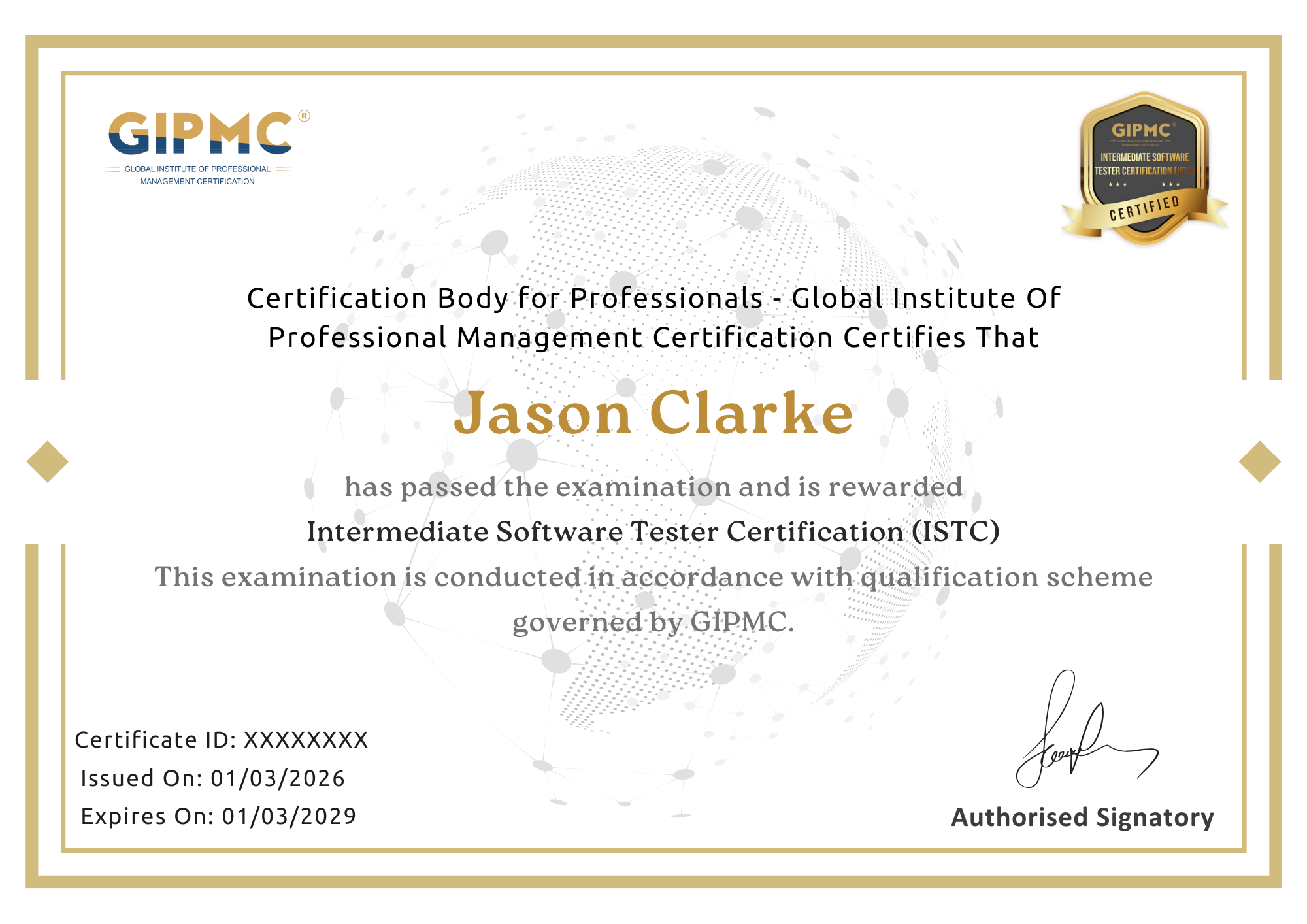
The Intermediate Software Tester Certification (ISTC) is valid for three (3) years from the date of award.
Renewal Objectives
- Maintain alignment with evolving testing practices
- Reinforce intermediate-level testing expertise
- Protect long-term credential value
Renewal Requirements
- Completion of approved professional development or testing knowledge refresh activities
- Successful renewal assessment or verification, as applicable
- Submission of renewal application prior to certification expiry
Timely renewal allows professionals to retain active certification status without interruption.